Introduction
The global poultry industry faces significant economic challenges derived from the contamination of raw materials and feed by mycotoxins (Chowdhury et al., 2005; Girish and Smith, 2008). Within the avian sector, the turkey (Meleagris gallopavo) stands out as one of the species with the highest susceptibility to these compounds, with examples of particular interest such as aflatoxin B1 (AFB1).
Aflatoxins
The initial identification of aflatoxins was intrinsically linked to avian pathology. The massive outbreak of the so-called “Turkey X Disease,” which occurred in the 1960s in the United Kingdom and resulted in a mortality of over 100,000 turkeys, defined a clinical picture of anorexia, lethargy, and severe liver necrosis and hemorrhage. Subsequent research confirmed Aspergillus flavus as the contaminant in the feed, enabling from that point forward the characterization of aflatoxins B1, B2, G1, and G2.
The exceptional sensitivity of the domestic turkey to AFB1 lies in a genetic particularity that limits its detoxification capacity: the limited ability of glutathione S-transferase (GST) enzymes to neutralize the toxin’s reactive metabolites. Following ingestion, AFB1 undergoes a hepatic bioactivation process that generates the metabolite exo-AFB1-8,9-epoxide (AFBO). This electrophilic metabolite possesses high carcinogenic and mutagenic potential, even exceeding that of AFB1. Due to the inefficiency of hepatic GST enzymes, AFBO is not effectively neutralized, leading to severe cellular damage, marked immunosuppression, and systemic compromise of the bird’s health (Kim et al., 2013; Reed et al., 2018; Jorud et al., 2024).
Clinically, exposure to aflatoxins translates into an immediate deterioration of performance indices, with drastic drops in growth rate, feed efficiency, and egg production (Aviagen Turkeys, 2018; Monson et al., 2014; Tilley et al., 2017; Nava-Ramírez et al., 2024). The liver, the primary target organ, exhibits macroscopic alterations including steatosis, fibrosis, and a characteristic pale or yellowish coloration (Monson et al., 2014; Aviagen Turkeys et al., 2018; Nava-Ramírez et al., 2024). Beyond hepatotoxicity, AFB1 acts as a potent immunosuppressant that increases susceptibility to secondary pathologies and compromises the integrity of the intestinal barrier, inducing dysbiosis and increased mucosal permeability (Monson et al., 2014; Maguey-González et al., 2024; Reed et al., 2018). It has also been observed in turkeys that aflatoxins interfere with vitamin D metabolism, which reduces bone strength and causes leg weakness (Aviagen Turkeys et al., 2018).
At a molecular level, the toxin interferes with the expression of critical genes linked to apoptosis and lipid metabolism. These systemic effects can be initiated even during embryonic development and manifest through alterations in blood biochemistry or variations in the relative weight of essential lymphoid organs, such as the spleen and the bursa of Fabricius (Monson et al., 2016; Tilley et al., 2017; Nava-Ramírez et al., 2024).
Trichothecenes: deoxynivalenol and T-2 toxin
Trichothecenes, such as deoxynivalenol (DON) and T-2 toxin, focus their pathogenicity on the disruption of tissues with a high rate of cell proliferation and protein turnover. The fundamental molecular mechanism of action of both metabolites lies in the inhibition of protein, RNA, and DNA synthesis through their specific binding to the ribosomal subunit. This blockade of protein translation prevents cell division and establishes trichothecenes as highly disruptive contaminants for the physiology and productive performance of turkeys (Chowdhury et al., 2005; Girish and Smith, 2008; Hassan et al., 2011).
In the digestive tract, both toxins drastically alter the mucosal architecture, resulting in shorter and thinner villi in the duodenum and jejunum, which significantly reduces the effective nutrient absorption area and feed efficiency (Girish and Smith, 2008).
Specifically, DON, also known as vomitoxin, compromises digestive function by inhibiting Na+-D-glucose and Na+-L-proline cotransporters, leading to a decrease in average daily gain (ADG), especially during the starter phases. At a systemic level, it acts as a potent immunomodulatory agent that increases biliary IgA levels by up to 4.45 times, evidencing active immunological stress in the mucosa that increases susceptibility to infectious agents. It is important to emphasize that DON toxicity in turkeys under field conditions is often exacerbated by its synergistic co-occurrence with other mycotoxins, such as zearalenone (ZEN) and fusaric acid (Hassan et al., 2011).
On the other hand, T-2 toxin stands out for its extreme cytotoxicity and irritant nature. In cases of acute toxicosis, it is associated with sudden death syndrome, showing necropsy, generalized hemorrhages and reddening of the breast muscles (Hassan et al., 2011). The appearance of oral lesions (Figure 1) and gizzard erosions can also be observed (Aviagen Turkeys et al., 2018). At a histological level, T-2 toxin acts as a potent immunotoxicant that induces apoptosis and necrosis in primary lymphoid organs such as the thymus and spleen, severely compromising the turkey’s immune competence (Girish and Smith, 2008).
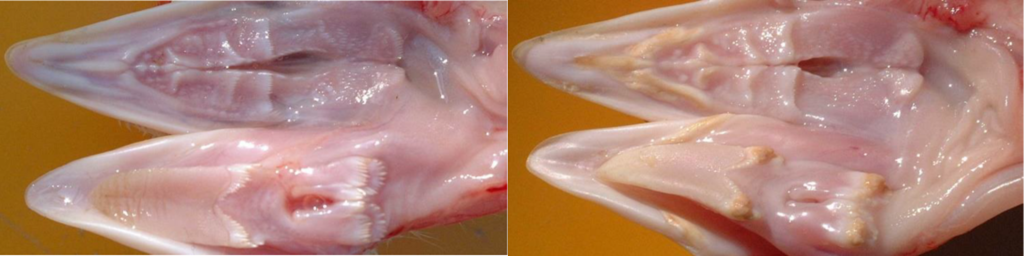
Figure 1. Oral lesions and necrosis caused by T-2 toxin. Normal oral cavity on the right; affected oral cavity on the left (Aviagen Turkeys et al., 2018).
Fumonisins
As in other poultry species, fumonisins in turkeys act primarily by disrupting sphingolipid biosynthesis through the competitive inhibition of ceramide synthase enzymes (CerS) (Guerre et al., 2022). This biochemical interference blocks the conversion of sphinganine into ceramides, causing an accumulation of free sphinganine that drastically increases the sphinganine:sphingosine ratio (Sa:So) in the liver and plasma. This parameter has become the standard diagnostic biomarker for monitoring exposure to these toxins under field conditions (Tardieu et al., 2019).
In turkeys and other poultry, the molecular response to fumonisins exhibits a distinctive dynamic: a reduction in medium-chain ceramides is observed, in contrast to an increase in very-long-chain ceramides and dihydroceramide levels. This specific metabolic configuration, combined with the lack of activation of sphingomyelin recycling pathways, would explain the greater resistance shown by these species to fumonisins compared to swine (Guerre et al., 2022).
However, chronic exposure is not without severe pathological consequences, manifesting in growth retardation, immunosuppression, and pulmonary edema. In episodes of acute toxicity, the observed lesions include splenomegaly, hepatomegaly, and hemorrhages in the renal parenchyma (Hassan et al., 2011). It is essential to warn that the systemic risk multiplies in the presence of synergistic co-occurrence with AFB1 or T-2 toxin, interactions that alter the plasma biochemical profile and increase mortality rates (Tilley et al., 2017).
From an intestinal health perspective, fumonisins compromise epithelial integrity, facilitating the translocation of opportunistic pathogens. A critical factor to consider in risk management is the pharmacokinetics of fumonisin B1 in turkeys. Despite rapid plasma clearance, it exhibits prolonged persistence in hepatic tissue, with an estimated elimination half-life of 124 hours. This bioaccumulation in the liver and muscle tissue underscores the importance of implementing effective control strategies to ensure food safety and animal health (Tardieu et al., 2019).
Ochratoxin A
Ochratoxin A (OTA) stands as one of the most critically impactful mycotoxins for the poultry industry, acting as a potent nephrotoxic and hepatotoxic agent in turkeys. Its cytotoxic mechanism of action is based on the inhibition of protein, DNA, and RNA synthesis, a process exacerbated by the stimulation of lipid peroxidation at the cellular level. Due to its high affinity for serum proteins, OTA exhibits a persistent distribution pharmacokinetics, accumulating in biologically active concentrations in the kidneys, liver, blood, and jejunal content. In young turkeys, even minimal dietary levels can compromise organic integrity and drastically compromise productive efficiency (Mazur-Kuśnirek et al., 2024).
Pathophysiologically, the OTA intoxication clinical picture manifests through marked hepatomegaly and nephromegaly, accompanied by generalized hemorrhages that also affect the spleen and pulmonary parenchyma. This systemic deterioration is directly reflected in productivity, with significant reductions in final body weight and voluntary feed intake. Furthermore, chronic exposure alters the blood biochemical profile, inducing hypoproteinemia and a decrease in serum gamma-globulins, clear indicators of severe compromise in protein metabolism and hepatic synthesis capacity. At the digestive level, alterations in pH during the digestion process have been documented in critical sections such as the cecum, suggesting a disruption of luminal balance (Hassan et al., 2011; Mazur-Kuśnirek et al., 2024).
The impact of OTA on the immune system is a determining factor for the profitability of the operation. As an immunotoxic agent, it depresses both cellular and humoral immunity, reducing the activity of key innate immunity effectors such as serum lysozyme and ceruloplasmin. This immunological gap not only increases the susceptibility of turkeys to opportunistic pathogens but also compromises the response to vaccination programs, invalidating preventive medicine strategies on the farm (Chowdhury et al., 2005; Mazur-Kuśnirek et al., 2024).
Zearalenone
Zearalenone (ZEN) is defined as a mycotoxin with estrogenic characteristics. Under field conditions, its detection is recurrent as a co-contaminant in cereals, commonly coexisting with DON, which complicates clinical diagnosis due to interactions between metabolites (Chowdhury et al., 2005). Compared to swine species, turkeys exhibit notable resilience to this toxin in terms of zootechnical parameters. Research using high experimental doses has confirmed that ZEN does not significantly compromise average daily weight gain, feed conversion ratio, or the relative weight of target organs, including the testes and ovaries (Tilley et al., 2017).
At a metabolic level, exposure to conventional ZEN levels does not induce alterations in the hepatic sphingolipid profile. Its physiological impact is often underestimated or masked by the more aggressive toxicity of other mycotoxins present in natural feed mixtures (Guerre et al., 2022). Nevertheless, the ingestion of massive concentrations can trigger an estrogenic response and specific ethological alterations. In males exposed to critical levels, exacerbated “strutting” behavior has been documented, linked to an increase in the turgidity and coloration of the caruncles, as well as inflammatory processes in the cloaca (Tilley et al., 2017).
From an immunological perspective, although ZEN in isolation has a limited impact, its inclusion in naturally contaminated diets can led to a moderate depression of cell-mediated immunity, specifically affecting the response of CD8+ T lymphocytes (Chowdhury et al., 2005; Tilley et al., 2017).
Conclusions
Mycotoxin-contaminated feed represents a significant threat to turkey production, as these toxins cause severe health issues that negatively impact both performance and animal welfare. Due to this impact, it is essential to implement strict control protocols and effective measures to reduce damage and protect farm profitability.
Despite the well-known effects of mycotoxins, further turkey-specific research is still required. We need a deeper understanding of their toxicity mechanisms and more precise safety thresholds. Only with solid technical knowledge can we develop management strategies and prevention solutions that truly address the needs of this species and ensure an optimal sanitary status.