Introduction
The use of phytogenic additives derived from agricultural by-products has become established as one of the most promising nutritional strategies to boost animal health and performance. Numerous studies demonstrate the benefits of grape extract (Vitis vinifera), an ingredient rich in antioxidant compounds with detoxifying and antimicrobial properties, widely used in animal production. Similarly, olive extract (Olea europaea) exhibits remarkable antioxidant and antimicrobial potential; it contains potent polyphenols that protect tissues from oxidative stress, contributing to balanced immune responses and, ultimately, to livestock health and performance (Agah et al., 2019; Almusawi et al., 2019; Kumanda et al., 2019; Tavakolinasab et al., 2020).
The combination of both ingredients promotes a synergistic interaction among their bioactive compounds, yielding an innovative solution with promising effects on animal performance: BIŌNTE® QUIMITŌX® LIVŌX®. Incorporating this liquid solution into drinking water supports animal health during periods of stress. Thanks to its potent antioxidant effect, it protects key tissues, while strengthening gut health and regulating the immune response. BIŌNTE® QUIMITŌX® LIVŌX® is intended for use during stressful periods in livestock production, such as early stages, vaccination, heat stress, or exposure to mycotoxins, among others.
BIŌNTE® QUIMITŌX® LIVŌX® against common, emerging, and modified mycotoxins
The proliferation of mycotoxins represents a constant global threat to both human and livestock health. These harmful fungal metabolites can contaminate any stage of the agri-food chain, spanning from crop cultivation and transport to the storage of raw materials, feeds, and finished products (Alkhalifah et al., 2022). In livestock, the ingestion of these toxins causes significant pathological alterations, including digestive disorders, lesions in key organs, and immune dysfunction, driven in part by the oxidative stress they generate at the cellular level. These tissue and organ alterations impair livestock productivity and negatively impact the profitability of livestock operations (Sun et al., 2022).
Scientific literature highlights that mycotoxin co-exposure synergistically exacerbates their adverse effects on animal health (Gruber-Dorninger et al., 2019). This issue is further compounded by the continuous identification of novel variants, such as emerging and modified mycotoxins, which significantly heighten analytical and toxicological complexity. Emerging mycotoxins are defined as toxic fungal secondary metabolites that are currently neither legislatively regulated nor routinely screened in standard surveillance protocols. Conversely, modified mycotoxins biotransformed by plant, fungal, or animal metabolism; these derivatives frequently exhibit toxicity comparable to their parent compounds, though higher or lower toxicity profiles may also occur (Alassane-Kpembi, 2024).
Several fungal genera synthesize emerging mycotoxins, with Alternaria spp. currently recognized as one of the most relevant genera, responsible for producing of potent metabolites such as tenuazonic acid. Animal exposure to this mycotoxin induces detrimental metabolic effects, most notably immunosuppression, hepatic damage, and various gastrointestinal disturbances. This systemic involvement directly translates into a negative impact on zootechnical parameters, leading to reduced weight gain, impaired feed conversion ratio (FCR), and, ultimately, compromised overall performance in livestock operations (Giambrone et al., 1978; Marin et al., 2014; Fraeyman et al., 2015).
BIŌNTE® QUIMITŌX® LIVŌX® against mycotoxicosis: Hepatic protection
BIŌNTE® QUIMITŌX® LIVŌX® is positioned as an essential product for addressing mycotoxicosis. Owing to the potent antioxidant effect of grape and olive extracts demonstrated in various in vitro studies, it has been demonstrated that this liquid solution protects hepatic cells from mycotoxin-induced oxidative stress by neutralizing the production of reactive oxygen species (ROS) (Jamshid Tabeshpour et al., 2018).
In the same vein, bioactive compounds from these natural ingredients have been reported to contribute to the hepatic detoxification of mycotoxins. Ali Rajput et al. (2017) reported a significant reduction in aflatoxin B1 (AFB1) residues in the livers of poultry supplemented with proanthocyanin from grape seed. Concurrently, studies focusing on olive-derived polyphenols have reported their ability to stimulate hepatic detoxification enzymes, thereby accelerating toxin metabolism and clearance (Abulnaja et al., 2022).
Thus, it is established that the extracts included in BIŌNTE® QUIMITŌX® LIVŌX® protect the liver through a dual mechanism. On one hand, they enhance its detoxifying properties by inducing and restoring the activity of metabolizing enzymes. On the other hand, they exert an antioxidant effect that neutralizes oxidative stress and inhibits lipid peroxidation, thereby preserving hepatocyte cell membrane integrity and preventing histological lesions caused by mycotoxin aggression.
Proven in vivo efficacy of BIŌNTE® QUIMITŌX® LIVŌX® against common and emerging mycotoxins
Based on this background, the present study was conducted in broiler chickens to evaluate the efficacy of BIŌNTE® QUIMITŌX® LIVŌX®, a synergistic combination of grape and olive extracts administered directly via drinking water. This study was carried out in collaboration with the University of Thessaly (Greece), as well as the MicroLab Biotech laboratories at the University of Valencia (Spain).
Experimental Design
The study included a total of 46,206 broiler chickens, Ross 308, allocated to two treatment groups, each comprising three replicates. The experimental groups consisted of: 22,950 animals exposed to a contaminated diet receiving no supplementation of any kind (control group); and 23,256 broiler chickens exposed to the same diet, supplemented with 0.5 mL/L of BIŌNTE® QUIMITŌX® LIVŌX® (treatment group).
The trial lasted 35 days, and at the beginning of the study, the common mycotoxins present in the naturally contaminated feed were analysed, revealing a co-contamination scenario:
| Mycotoxin | Contamination (ppb) | Risk level |
|---|---|---|
| Aflatoxin B1 (AFB1) | 3.15 | Low |
| Fumonisins | 390.5 | Low |
| Ochratoxin A (OTA) | 0.99 | Low |
| Deoxynivalenol (DON) | 172.5 | Low |
| Zearalenone | 80.9 | Low |
| T-2/HT-2 Toxin | 53.2 | Medium |
To determine the impact of mycotoxins and the protective effect of BIŌNTE® QUIMITŌX® LIVŌX®, the feed efficiency of the animals was monitored, and markers of oxidation and liver damage were evaluated. Additionally, the relative abundance of tenuazonic acid in the liver was analysed to assess the detoxifying properties of the liquid solution. Thus, the objective was to validate the benefits of the phytogenic extracts present in BIŌNTE® QUIMITŌX® LIVŌX® and their impact on livestock.
Results
Supplementation with BIŌNTE® QUIMITŌX® LIVŌX® contributed to greater feed efficiency in the treated broiler chickens. Analysis of feed conversion ratio (FCR) revealed a 5% difference between both groups, suggesting that the liquid solution contributed to the overall health of the animals by improving their immune status and intestinal balance, which translated into enhanced productive performance. The individuals that received BIŌNTE® QUIMITŌX® LIVŌX® utilized feed more efficiently, successfully achieving performance targets despite exposure to mycotoxins via the feed.
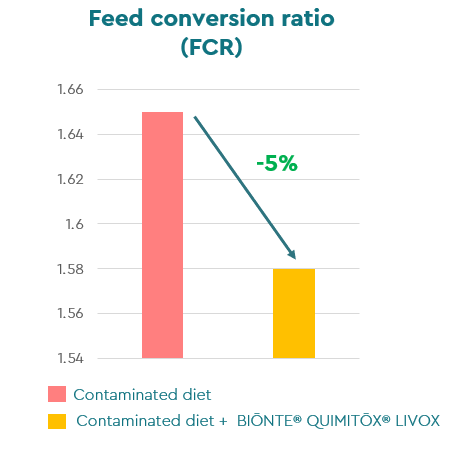
Figure 1.Feed conversion ratio in broiler chickens exposed to mycotoxins with and without BIŌNTE® QUIMITŌX® LIVŌX®.
The results obtained regarding oxidation markers confirmed the antioxidant properties of BIŌNTE® QUIMITŌX® LIVŌX®. After the 35-day experimental period, a significant reduction in the concentration of thiobarbituric acid reactive substances (TBARS) and protein carbonyls (CARBs), markers of lipid and protein oxidation processes, respectively, was observed. Similarly, a considerable increase in total antioxidant capacity (TAC) was recorded, demonstrating that BIŌNTE® QUIMITŌX® LIVŌX® alleviated the mycotoxin-induced oxidative stress and reinforced the antioxidant defences of the supplemented animals, thanks to its formulation based on natural polyphenol-rich extracts (Wang et al., 2008; Farahat et al., 2017).
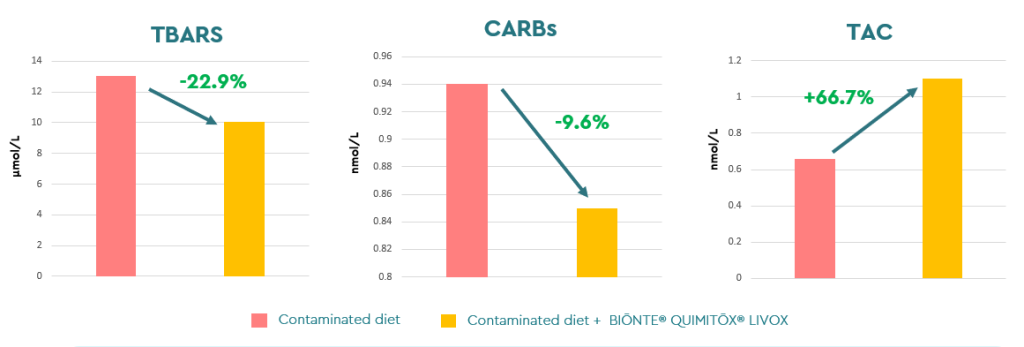
Figure 2.Biomarkers of oxidative stress in broiler chickens exposed to mycotoxins with and without BIŌNTE® QUIMITŌX® LIVŌX®.
On the other hand, the analysis of liver enzymes demonstrated the hepatoprotective properties of the solution. Lower concentrations of liver damage biomarkers, such as alanine aminotransferase (ALT), aspartate aminotransferase (AST), and alkaline phosphatase (ALP), were observed in the group supplemented with BIŌNTE® QUIMITŌX® LIVŌX®. Thanks to the protective effects of grape and olive extracts at the cellular level, as well as their anti-inflammatory capacity, this liquid solution reinforces the integrity and functionality of this key organ (Zhang, 2011).
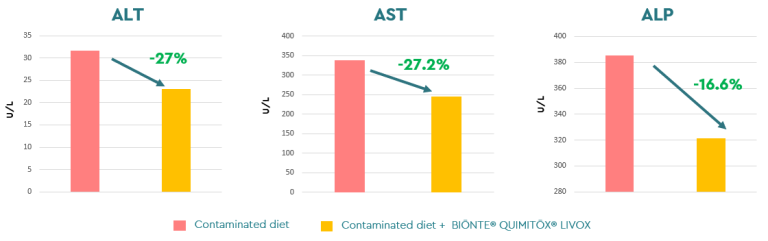
Figure 3.Biomarkers of liver damage in broiler chickens exposed to mycotoxins with and without BIŌNTE® QUIMITŌX® LIVŌX®.
Regarding the quantification of mycotoxins in the liver, the analysis of the relative abundance of tenuazonic acid revealed a potent detoxifying effect of BIŌNTE® QUIMITŌX® LIVŌX®. The livers of the birds supplemented with the phytogenic solution showed an 83% reduction in the relative abundance of this emerging mycotoxin, highlighting the product’s ability to protect this target organ. Thanks to this hepatic analysis, the present study demonstrates the efficacy of BIŌNTE® QUIMITŌX® LIVŌX® in a mycotoxicosis scenario.
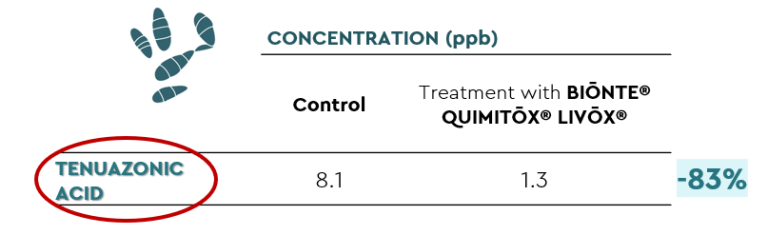
Figure 4. Relative abundance of tenuazonic acid in broiler chickens exposed to mycotoxins with and without BIŌNTE® QUIMITŌX® LIVŌX®.
Conclusions
In conclusion, the addition of BIŌNTE® QUIMITŌX® LIVŌX®, a liquid solution based on grape and olive extracts rich in bioactive compounds, proves to be a high-impact preventive strategy under stressful conditions for broiler chickens, such as mycotoxin contamination.
BIŌNTE® QUIMITŌX® LIVŌX® improves productive performance in supplemented animals, exhibiting improved feed conversion ratios while reinforcing their antioxidant capacity and contributing to liver health, which is essential in high-producing animals. Finally, through the monitoring of mycotoxins in the liver, the detoxifying properties of this liquid solution are demonstrated capable of reducing the accumulation of tenuazonic acid in this vital organ by up to 83%.