Introduction
The profitability of poultry production directly depends on the optimal performance of breeder hens. Maintaining appropriate conditions both during their initial development and during their laying stage is crucial for the rest of the production chain (McKenna et al., 2020). For this reason, controlling various nutritional risk factors, among which mycotoxin contamination is positioned, must be one of our priorities.
Mycotoxins are highly prevalent contaminants frequently detected in raw materials and feed, compromising the health and performance of different animal species (Yegani et al., 2006). These toxins generate significant economic losses worldwide, and we must pay special attention to their control and mitigation (Hussein and Brasel, 2001).
Specifically, these contaminants negatively affect the health and performance of breeder birds, compromising egg hatchability and increasing embryonic mortality rates (Song et al., 2023). Their oxidative and inflammatory effects have been linked to the alteration of liver health and the reproductive tract of these animals, compromising egg production and quality (Ruan et al., 2023). On the other hand, mycotoxins alter the immune function of breeder hens, reducing the efficacy of vaccination programs and hindering the transfer of maternal immunity from females to chicks (Song et al., 2023).
Effects of mycotoxins on breeder health and embryonic development
Aflatoxin B1
Among common mycotoxins, those that are regulated and typically included in routine monitoring programs, aflatoxins stand out as some of the most toxic. Specifically, regarding aflatoxin B1 (AFB1), its carcinogenic effects are well-documented.
These mycotoxins induce a significant hepatotoxic and immunotoxic effect, in addition to compromising nutrient absorption at the intestinal level. Exposed hens experience a decrease in laying rate, as well as reduced egg quality.
In breeder hens, AFB1 has been linked to issues in embryonic chick development, as well as declines in fertility rates. This is partly due to the transfer of these mycotoxins into the eggs. Such transfer is associated with the hatching of weaker chicks exhibiting functional impairment and greater disease susceptibility (Qureshi et al., 1998).
Zearalenone
Zearalenone is another of the most dangerous mycotoxins for breeder females. It is an estrogenic toxin, as its chemical structure resembles the natural hormone 17β-estradiol, causing it to disrupt the animals’ hormonal balance (Moura et al., 2026). Thus, it is characterized by triggering alterations in gametogenesis and embryonic development, as well as reducing egg production and causing hypertrophy in the reproductive tract, which leads to severe performance problems (Moura et al., 2026).
Regarding egg quality and embryonic development, zearalenone has been associated with a decrease in Haugh units (internal egg quality), reduced fertility, and increases in embryonic mortality (Yegani et al., 2006; Allen et al., 1981).
Yuan et al. (2026) reported mucosal alterations in the duodenum and jejunum, as well as villous vacuolation and an increased villus-to-crypt ratio in the ileum of 20-day-old chicks resulting from embryonic exposure to zearalenone (Figure 1).
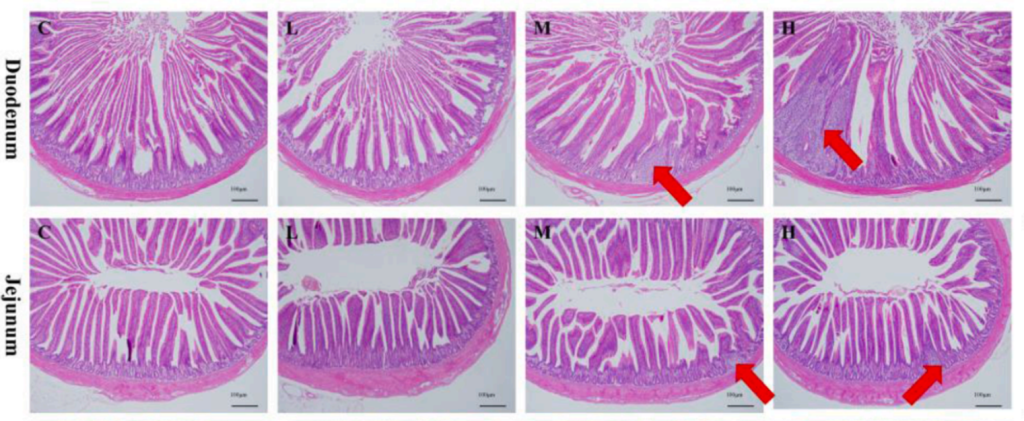
Figure 1: Histopathological sections from 20-day-old chicks following embryonic exposure zearalenone: inflammatory infiltration (red arrows) in the mucosa of the duodenum and jejunum. (Control (C): 0 µg; Low (L): 5 µg; Medium (M): 50 µg; High (H): 500 µg/egg).
Regarding egg quality, zearalenone has been associated with a decline in Haugh units (internal egg quality), as well as reduced fertility rates and increased embryonic mortality (Yegani et al., 2006; Allen et al., 1981).
Ochratoxin A
Commonly recognized for its nephrotoxic effect, ochratoxin A (OTA) significantly alters the health of breeder hens. This mycotoxin compromises hepatic and reproductive health, disrupting bird growth and immune response. Effects such as smaller produced egg size, along with inflammatory reactions at the liver and kidney levels, have been reported by Zahoor-ul-Hassan et al. (2010) in breeder hens exposed to OTA (Figure 2 and 3). In the same line, Lee et al. (2023) recorded lower egg production and fertility in exposed animals.
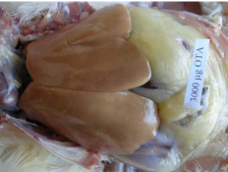
Figure 2: Liver of a hen fed feed contaminated with 3 mg/kg of OTA. Enlarged and pale liver (Zahoor-ul-Hassan et al., 2010).
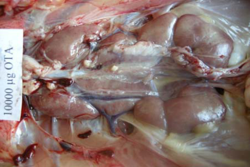
Figure 3: Kidneys of a hen fed feed contaminated with 10 mg/kg of OTA. Swollen kidneys protruding from the pelvic cavity (Zahoor-ul-Hassan et al., 2010).
On the other hand, the transfer of OTA has been widely reported in various animal tissues, as well as in eggs. For this reason, this mycotoxin is considered by some authors as having the highest embryotoxic potential, attributed to the disruptions it causes in different metabolic pathways during embryonic development (Lee et al., 2023).
Furthermore, OTA is associated with the dysregulation of mineral absorption mechanisms, which negatively affects bone mineralization and egg quality, the latter being a critical issue during the incubation stage (Lee et al., 2023; Qubih, 2011).
Trichothecenes: Deoxynivalenol and T-2 toxin
Deoxynivalenol (DON) and T-2 toxin are grouped within the mycotoxins recognized as trichothecenes, highly toxic compounds that pose a threat to poultry health (Doll and Danicke, 2004). These alter rapidly regenerating tissues, with the immune system, liver, and small intestine being the most affected (Yegani et al., 2006).
Yegani et al. (2006) reported a reduction in eggshell thickness in breeder hens exposed to DON. This finding was linked to the high early mortality recorded, as eggshell quality is a decisive factor for success during incubation (Leeson and Summers, 2000). On the other hand, it is known that these mycotoxins alter nutrient composition and availability in eggs, which can also be associated with embryonic development and survival issues (Yegani et al., 2006).
Regarding the transfer of trichothecenes into eggs, to date, the detected amounts of DON do not pose a risk to embryonic development (Sypecka et al., 2004). In the case of T-2 toxin, its embryotoxic potential has been reported; however, its effect is not comparable to that of AFB1 or OTA (Veselý et al., 1992).
Fumonisins
As the most prevalent group of mycotoxins worldwide, fumonisins are associated with hepatotoxicity, intestinal disruption, immunosuppression, and the disruption of sphingolipid metabolism in birds (Ramona et al., 2025).
The immunotoxicity of these compounds reduces individual lymphoid proliferation as well as cytokine production, which compromises the immune response of breeder hens and can be linked to issues in immunity transfer to chicks. On the other hand, these mycotoxins accumulate in tissues such as the liver, muscle, or eggs, although to date no significant risk associated with this finding has been reported.
Field reality: Co-contamination scenarios
It is worth noting that, under real field conditions, the usual scenario involves the simultaneous presence of several mycotoxins, triggering additive or synergistic effects where the combined toxicity frequently exceeds the sum of their individual impacts (Smith et al., 2021; Alassane-Kpembi et al., 2017). This interaction aggravates hepatotoxicity, immunosuppression, and intestinal barrier disruption in breeders, multiplying hatchability issues, shell quality deterioration, and embryonic mortality.
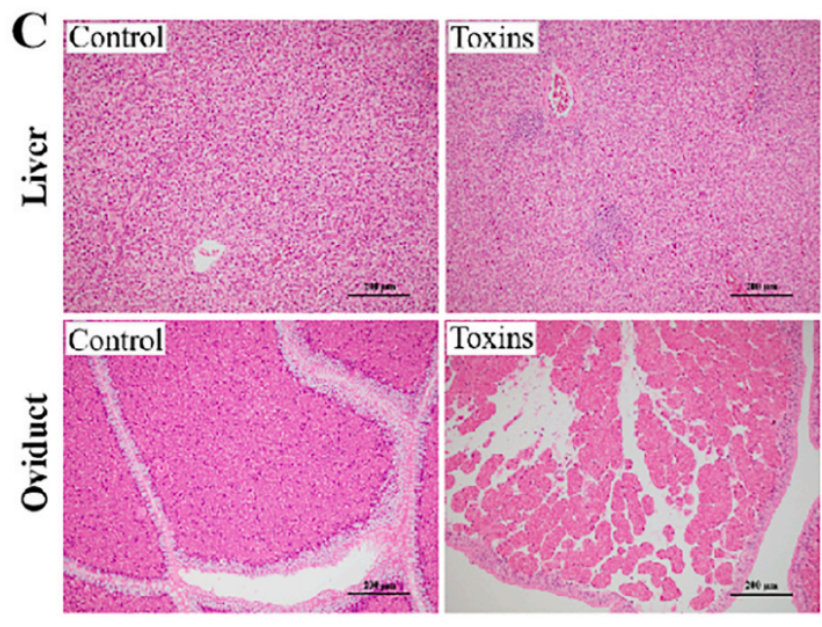
Figure 4: Histopathological lesions in hens induced by a co-contamination scenario (AFB1, DON, and OTA): multifocal inflammation, vacuolar degeneration, and necrosis in the liver, along with rupture and shedding of mucosal villi in the oviduct (Ruan et al., 2023).
Therefore, risk assessment should not be limited to the individual analysis of each toxin, making it essential to implement comprehensive, broad-spectrum mitigation strategies that protect hen health and ensure chick viability.
Repercussions of mycotoxin exposure in day-old chicks
The health of chicks at hatch determines their initial starting potential and uniformity throughout the entire cycle. Therefore, evaluating various physical, physiological, and health parameters is essential, serving as a very useful tool for detecting possible disruptions caused by mycotoxins.
Intestinal, hepatic, and immunological alterations induced in breeder hens can lead to chicks with lower hatch weights due to the nutritional deficits they were exposed to during their development. These animals appear apathetic and are associated with poor muscle tone. The lack of reserves at hatch is linked to reduced viability, as well as greater susceptibility to secondary infections, since the transfer of maternal immunity has been compromised (Yuan et al., 2006; Moon et al., 2007; Yegani et al., 2006).
Mycotoxins primarily associated with embryotoxicity, AFB1, OTA, and T-2 toxin, are linked to unhealed wet navel issues. The presence of larger yolk sacs or signs of inflammation, as well as pale livers and kidneys, or petechial hemorrhages, is also related to maternal mycotoxin exposure.
Furthermore, mycotoxins compromise flock uniformity, increasing body weight dispersion, as they can affect individual birds unequally. This leads to higher mortality during the first week of life and a greater prevalence of enteropathies.
Conclusion
The presence of mycotoxins in breeder nutrition represents a silent yet decisive threat to poultry profitability. The impact extends beyond the health of the hen: it compromises internal egg quality, weakens the shell, triggers embryonic mortality, and alters the health of chicks at hatch.
Since co-contamination is the rule rather than the exception, monitoring toxins individually is not enough. It is imperative to adopt comprehensive control programs that combine periodic raw material analysis with the preventive use of broad-spectrum anti-mycotoxin solutions. Ensuring the hepatic and intestinal health of the breeder is the only way to guarantee strong, uniform, and highly productive day-old chicks.