Introduction
Global consumption of fisheries and aquaculture resources has recorded sustained growth, with an average annual rate of 3% since 1961. This sectoral dynamism is driven by aquaculture, whose production volume has progressively surpassed that of traditional capture fisheries.
Within this context of expansion, salmonid farming has consolidated its position as one of the highest-value segments in global aquaculture. Despite the fact that, in terms of absolute volume, it does not compete with the most produced species, such as continental carps and tilapias. Nonetheless, it stands out for its high profitability, advanced technological development, and a highly integrated global supply chain designed to meet the growing demand of middle and high-income markets (FAO, 2022).
The leading example of this success is the Atlantic salmon (Salmo salar), a species that leads investments in genetic innovation and automated offshore farming systems. Its large-scale production (concentrated mainly in Norway and Chile) has standardized its global consumption, transforming it from a seasonal luxury product into one of the most stable and widely consumed marine protein sources in the international market (Asche et al., 2018).
The rainbow trout (Oncorhynchus mykiss) complements this landscape, offering great geographical and production versatility. Unlike Atlantic salmon, whose development is predominantly marine, trout is farmed mainly in continental freshwater systems, although its remarkable plasticity also allows it to successfully adapt to estuarine and marine environments. This farming flexibility has fostered the growth of local industries in Europe, Latin America, and Iran.
The intensification of culture systems for these species, which are predominantly carnivorous, requires high-protein diets. To satisfy this biological demand on a large scale, the aquaculture sector has traditionally used fishmeal as the main ingredient to cover the protein requirements of different species. However, its high cost has driven a transition towards more cost-effective plant-based raw materials, such as soy and corn. Nevertheless, this modification in the formulation of aquafeeds has introduced several challenges, notably a higher risk of fish exposure to mycotoxins.
Mycotoxins are toxic secondary metabolites produced by various species of fungi that frequently contaminate food and feed (Gruber-Dorninger et al., 2019). They represent a global food safety challenge, affecting humans through the direct consumption of contaminated plant-derived products or indirectly through animal products derived from exposed livestock.
Mycotoxins in aquaculture
In aquaculture, the risk of mycotoxins is not limited to feed intake. These toxins may persist in water and sediments, increasing the exposure of cultured species, thereby compromising animal health and productivity while compromising the safety of final consumers.
The main effects include oxidative stress, histopathological alterations in gills and liver, behavioral changes, reduction in weight gain, and even death. These effects vary not only based on the species and its productive stage, but also according to the type of mycotoxin, the ingested concentration, and the exposure time (Oliveira et al., 2020). Furthermore, their high thermostability allows them to resist thermal treatments and standard processing methods used in aquafeed production (Gbashi et al., 2019; Sueck et al., 2019).
Mycotoxins in salmonids
Aflatoxin B1
Aflatoxins are mycotoxins produced mainly by fungi of the genera Aspergillus and Penicillium. Among them, aflatoxin B1 (AFB1) stands out for its marked toxicity and potential carcinogenic effect, being classified in Group 1 of the World Health Organization (WHO) (Yu et al., 2024).
Marked liver damage has been reported in species such as rainbow trout due to dietary exposure to AFB1. This damage is characterized by an increase in the levels of oxidative stress biomarkers, such as malondialdehyde (MDA), and a concomitant inhibition of key antioxidant enzymes like catalase (CAT) and superoxide dismutase (SOD). At higher doses, AFB1 also causes gastrointestinal damage through the destruction of intestinal microvilli (Ghafarifarsani et al., 2021).
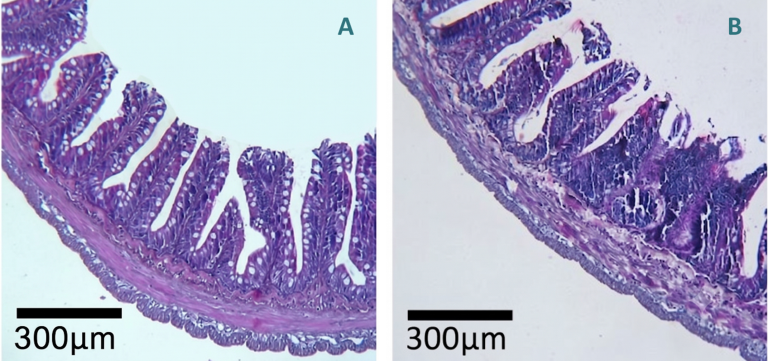
Figure 1. Histological section of the proximal intestine of rainbow trout (Oncorhynchus mykiss). (A) Intact tissue (B) Destruction of the villi (Ghafarifarsani et al., 2021).
Furthermore, it compromises the innate immune system, decreasing the levels of lysozyme (Lys) and total immunoglobulins (Ghafarifarsani et al., 2021).
As a consequence of this physiological and metabolic detriment, the growth performance of the species undergoes a marked decrease in specific growth rate (SGR) and an increase in the feed conversion ratio (FCR) (Ghafarifarsani et al., 2021).
Ochratoxin A
Ochratoxins are produced by fungi of the genera Aspergillus and Penicillium, and are classified into three types: ochratoxin A (OTA), B (OTB), and C (OTC) (Ruan et al., 2023). OTA stands out for its marked renal and hepatic toxicity. In Atlantic salmon, various hepatic and biliary lesions have been recorded, evidenced by increased plasma levels of alkaline phosphatase (AP) and aspartate aminotransferase (AST) (Bernhoft et al., 2018).
Additionally, it alters the immune response, which is evidenced by an increased splenic mRNA expression in the spleen (Bernhoft et al., 2018).
Deoxynivalenol
Deoxynivalenol (DON), produced mainly by fungi of the genus Fusarium, represents a critical hazard in Atlantic salmon due to the phenomenon of carry-over. This is due to its high absorption rate and extremely slow elimination from the organism, resulting in significant accumulation of the toxin in muscle, liver, and brain tissues (Bernhoft et al., 2017).
The presence of the toxin significantly reduces cholesterol, total protein, and albumin levels in plasma. At higher concentrations, it directly affects liver metabolism, depressing alkaline phosphatase activity and inducing an increase in the relative liver weight. Likewise, marked hematological alterations occur at the hematological level, manifested as a marked decrease in hematocrit (Bernhoft et al., 2018).
In parallel, the fish’s natural defenses are severely compromised. The integrity of the epithelial barrier is significantly affected, which is accompanied by a reduction in the expression of inflammatory cytokines (Moldal et al., 2018). This structural weakening also extends to the adaptive immune response, reducing antibody production post-vaccination (Bernhoft et al., 2018).
Finally, a drastic reduction in feed intake and the condition factor of the specimens takes place, culminating in a severe drop in overall growth and a markedly lower weight gain (Bernhoft et al., 2017; Bernhoft et al., 2018).
Zearalenone
Zearalenone (ZEN) is a mycotoxin produced by fungi of the genus Fusarium, commonly associated with hormonal alterations due to its structural similarity to estrogens. Dietary exposure to ZEN causes severe endocrine alterations in rainbow trout.
In males, it induces a highly significant increase in plasma vitellogenin, which acts as a key indicator of estrogenic exposure, as well as intersexuality, sexual reversal, and testicular atrophy or reduced testicular size. Conversely, in females, the increase in vitellogenin is mild, and the development of asymmetrical ovaries is observed (Woźny et al., 2020).
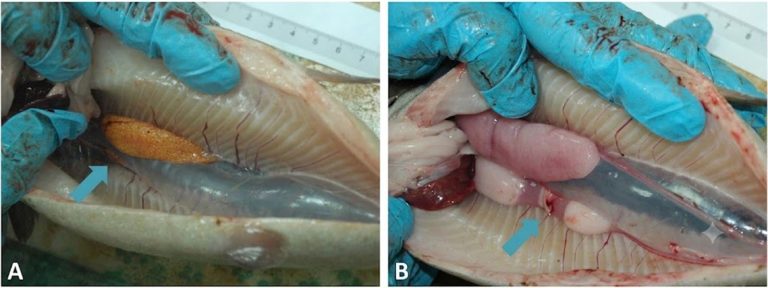
Figure 2. Gonadal development disorders in rainbow trout (Oncorhynchus mykiss) exposed to ZEN. (A) Disproportionate ovaries (B) Testicular lobe fragmentation (Woźny et al., 2020).
Intraperitoneal administration of high doses induces metabolic and hematological alterations at the cellular level, characterized by a decrease in iron concentrations in liver and ovarian tissues (Woźny et al., 2012).
Emerging mycotoxins
The term “emerging mycotoxins” refers to compounds that, despite having scientific evidence regarding their toxicity in humans and animals, are not yet subject to legal regulations or systematic analytical controls (Arroyo-Manzanares et al., 2019; Khoshal et al., 2019; Krug et al., 2018). Interest in these compounds has grown significantly in recent years, driven mainly by their recurrent detection in raw materials and feed used in the livestock industry (Hasuda et al., 2023).
Beauvericin (BEA), produced mainly by fungi of the genera Beauveria and Fusarium, causes marked anemia in Atlantic salmon. This effect is manifested by the alteration of hematological and endocrine biomarkers, such as the decrease in erythropoietin, as well as an overexpression of oxidative stress regulators (Soderstrom et al., 2023).
Enniatin B (ENNB), also synthesized by species of the genus Fusarium, induces acute inflammation in the intestinal tissue of Atlantic salmon, a phenomenon evidenced at the molecular level through the altered expression of haptoglobin (Hp)-related genes (Soderstrom et al., 2023).
Conclusion
The transition towards diets with a higher proportion of plant-based ingredients in aquaculture has optimized the economic profitability of the industry, but directly increases the vulnerability of feeds to mycotoxin contamination.
In the farming of highly sensitive species like Atlantic salmon and rainbow trout, the presence of these fungal metabolites represents a critical challenge that triggers severe liver damage, immunosuppression, reproductive alterations, and the latent risk of toxin transfer (carry-over) to tissues. Therefore, rigorous management and analytical monitoring are indispensable, not only to safeguard the health and productive performance of the fish, but to ensure the sustainability and efficiency of the sector and maximum food safety in the global market.