Introduction
The consumption of seafood and aquaculture products has grown steadily worldwide, with an average annual increase of 3% since 1961. This growth has driven the expansion of the aquaculture sector, whose production has progressively surpassed that of traditional capture fisheries.
In Mediterranean aquaculture, marine farming has expanded rapidly as an alternative to the constraints imposed by limited freshwater resources. This has positioned gilthead seabream (Sparus aurata) and European seabass (Dicentrarchus labrax) as two of the most cultivated and highest-value species in the region (FAO, 2022).
Gilthead seabream stands out for its high physiological plasticity, as a euryhaline and eurythermal species, allowing it to tolerate broad variations in temperature and salinity to adapt to both the open sea and estuaries and coastal lagoons. Conversely, European seabass is a coastal predator valued for its robustness, ecological adaptability, and rapid growth during juvenile stages. The commercial success of both species relies on the consolidation of captive breeding techniques, high nutritional quality, and strong market demand, factors that have transformed their production from traditional capture fisheries into a standardized marine aquaculture sector.
The production of these two species is often closely linked, as both are carnivorous marine fish with a strong presence in the European market. Together, they represent two of the most cultivated marine fish species in the Mediterranean, with Greece and Italy among the leading producing countries. Because they share farming environments and production systems, both species face similar management challenges, such as optimizing feeding and grow-out strategies according to body weight to reach market sizes.
Additionally, both face the primary sustainability challenge of the modern aquaculture industry: the transition from fishmeal and fish oil to plant protein sources in commercial diet formulations. This nutritional transition has exposed both species to new stress factors, highlighting their shared vulnerability to natural contamination by mycotoxins present in plant-based feed ingredients.
Mycotoxins are toxic secondary metabolites produced by various fungal species that frequently contaminate food and feed (Gruber-Dorninger et al., 2019). They represent a global food safety challenge, affecting humans directly through the consumption of contaminated crops and indirectly through foods derived from exposed animals.
Mycotoxins in aquaculture
In aquaculture, the risk of mycotoxins extends beyond direct feed consumption. These toxins can persist in water and sediment, increasing the exposure of farmed species, potentially impairing their health and growth performance, and posing a risk to food safety for the end consumer.
From a toxicological perspective, clinical effects range from oxidative stress and histopathological damage in the liver and gills to behavioral alterations, reduced growth, and increased mortality. The severity of these conditions depends not only on the species and its developmental stage, but also on the nature of the mycotoxin, the dose ingested, and the duration of exposure (Oliveira et al., 2020).
It is worth noting the high thermal resistance of these compounds, which allows them to withstand the temperatures and processes commonly used in industrial aquafeed processing, such as extrusion (Gbashi et al., 2019; Sueck et al., 2019).
Mycotoxins in gilthead seabream and European seabass
Aflatoxin B1
Aflatoxins are mycotoxins produced mainly by fungi belonging to the genera Aspergillus and Penicillium. Among them, aflatoxin B1 (AFB1) is notable for its high toxicity and carcinogenic potential, and is classified as a Group 1 carcinogen to humans by the International Agency for Research on Cancer (Yu et al., 2024).
In gilthead seabream, Barany et al. (2021) reported a broad spectrum of clinical signs and performance deficits following dietary exposure at 1 mg/kg. AFB1 toxicity is mediated by pronounced oxidative stress, manifested as a marked depletion of glucose and total triglyceride concentrations in plasma and liver, as well as reductions in hematocrit. These metabolic disturbances, in turn, triggered alterations in the hepatosomatic index and marked hepatic necrosis.
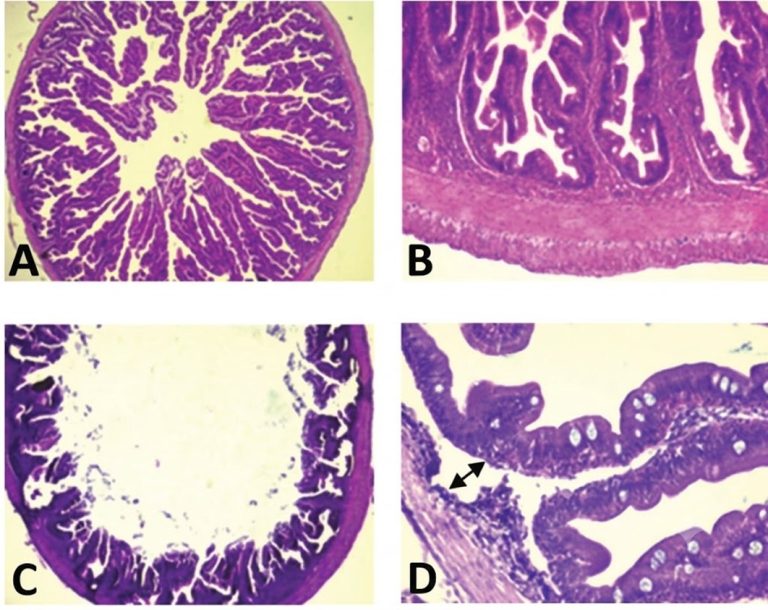
Figure 1. Histological sections of the anterior intestine of juvenile gilthead seabream fed a mycotoxin-free diet (A, B) and diets supplemented with AFB1 (C, D). (A) Anterior intestine of healthy animals. (BAnterior intestine showing the intestinal layers and villi in detail. (C) Anterior intestine with necrosis of epithelial villi. (D) Infiltration and formation of subepithelial spaces. (Barany et al., 2021)
Organ damage was not limited to hepatic toxicity; it also caused tubular cell degeneration and tubular retraction in the kidneys. At the gastrointestinal level, microscopic tissue damage was detected in the anterior intestine, including epithelial necrosis, villus shortening, and infiltration, as well as dysregulation of key tight junction proteins such as claudins and occludins.
The presence of AFB1 also altered growth regulation and induced markers of the systemic neuroendocrine stress response, downregulating the expression of insulin-like growth factor 1 (IGF-1) and upregulating that of thyrotropin-releasing hormone (TRH), corticotropin-releasing hormone (CRH), and steroidogenic acute regulatory protein (STAR).
These effects led to severe growth inhibition in the animals, with a reduction of up to 80% in their final weight compared to healthy individuals.
Regarding its effects on European seabass, El-Sayed et al. (2009) reported a wide range of responses depending on whether exposure was acute or chronic and on the live weight of the animals. At acute exposure levels (starting from 0.05 mg/kg body weight), signs of neurotoxicity were observed, such as lethargy and ataxia. These were accompanied by various forms of multiorgan damage, including dorsal hemorrhages, hepatic, renal, and branchial congestion, hemorrhage in the abdominal cavity, muscle spasms, and increased mortality, with an LD50 of 0.18 mg/kg AFB1.
Under prolonged exposure to lower doses (starting from 0.018 mg/kg body weight) over longer periods, several clinical signs became apparent, such as body darkening, petechiae, ocular opacity, exophthalmia, ascites, severe emaciation, pallor of the gills and liver, and gallbladder distension.
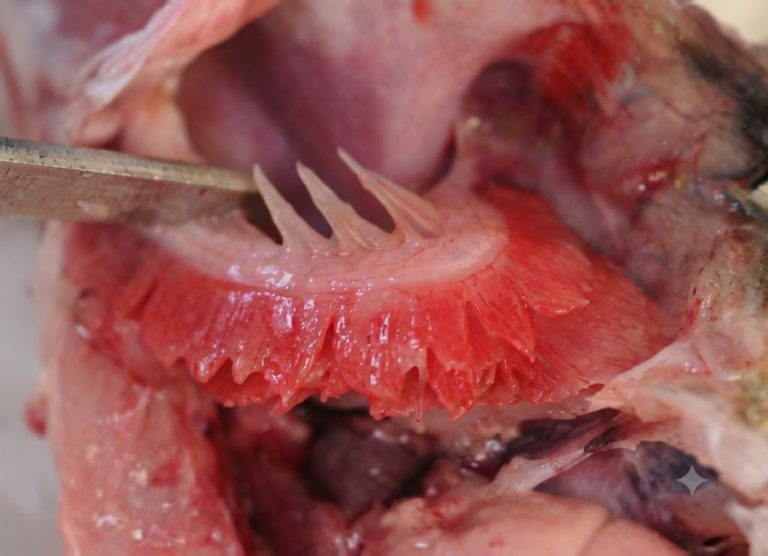
Figure 2. Gill pallor, a clinical sign associated with various stress factors, such as exposure to mycotoxins. Adapted from Salogni et al. (2024).
Hematological profiling revealed that AFB1 induced an increase in the liver injury markers alanine aminotransferase (ALT), aspartate aminotransferase (AST), and alkaline phosphatase (ALP), while also reducing total protein, albumin, and globulin concentrations.
Finally, El-Sayed et al. (2009) also documented the carryover of AFB1 into edible muscle tissue, highlighting once again the food safety risk associated with contaminated aquafeeds.
Fumonisin B1
Fumonisins are mycotoxins produced by species of the genus Fusarium. Fumonisin B1 (FB1) is considered the most toxic, and is typically associated with nephrotoxicity and hepatotoxicity in animals.
Mello et al. (2025) demonstrated that dietary doses of 0.15 mg/kg are capable of inducing severe oxidative stress in juvenile gilthead seabream. This was characterized by alterations in superoxide dismutase (SOD) activity and total antioxidant capacity in the gills. This oxidative damage was also associated with signs of hepatic toxicity, such as a reduction in the hepatosomatic index and an increase in ubiquitin levels in the liver, a biomarker associated with protein degradation.
In another study conducted with juvenile gilthead seabream, Gonçalves et al. (2020) recorded detrimental effects caused by FB1 doses of 0.168 mg/kg on performance parameters such as feed conversion ratio (FCR) and protein efficiency ratio (PER). In addition, alterations in the innate immune response were documented, manifested through changes in respiratory burst activity in circulating leukocytes.
Ochratoxin A
Ochratoxins are produced by fungi of the genera Aspergillus and Penicillium and are mainly classified into three types: ochratoxin A (OTA), B (OTB), and C (OTC) (Ruan et al., 2023).
OTA is notable for its marked renal and hepatic toxicity. Furthermore, similar to what has been observed with AFB1, its presence in feed poses an additional risk of tissue transfer or accumulation (carryover), thereby posing a potential risk to consumers.
Meucci et al. (2021) monitored and reported natural OTA bioaccumulation in products from the Italian market, detecting levels of up to 0.91 µg/kg in the kidney, 0.74 µg/kg in the liver, and 0.28 µg/kg in the muscle.
T-2 Toxin
T-2 toxin belongs to the group of type A trichothecenes, which are synthesized by fungi of the genus Fusarium.
Al-Souti et al. (2026) reported a broad spectrum of histopathological lesions in gilthead seabream specimens following exposure to a dietary dose of 0.5 mg/kg of this toxin. At the tissue level, hepatomegaly was observed, accompanied by hepatic and pancreatic vacuolation, renal tubular necrosis, and severe branchial damage. Concurrently, the toxin triggered acute oxidative stress, characterized by increased levels of malondialdehyde (MDA) and the depletion of key antioxidant enzyme activities such as superoxide dismutase (SOD), catalase (CAT), and glutathione S-transferase (GST). Likewise, a suppression of the innate immune response was recorded, as evidenced by reduced macrophage activity and lysozyme activity, as well as decreased serum bactericidal capacity.
Additionally, Abdelrahiem et al. (2023) reported that dietary T-2 doses of 1 mg/kg intensified these detrimental effects, causing severe anemia, fusion of gill lamellae, and high mortality rates.
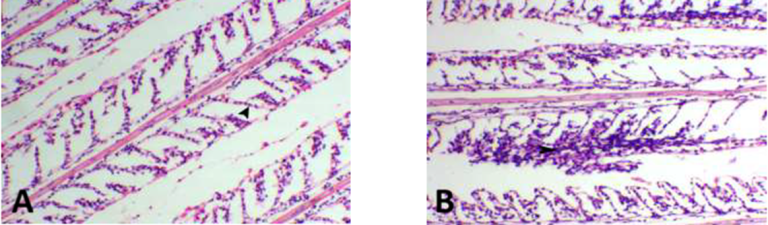
Figure 3. Histological sections of gilthead seabream gills. (A) Gill lamellae of healthy individuals. (B) Adhesion of the gill lamellae following dietary exposure to T-2 toxin (Abdelrahiem et al., 2023).
Zearalenone
Zearalenone (ZEN) is a mycotoxin produced by species of the genus Fusarium, typically associated with hormonal alterations and reproductive disorders due to its structural similarity to endogenous estrogens.
However, according to Abdel-Tawwab et al. (2020, 2021), ZEN contamination at dietary doses starting from 0.725 mg/kg in European seabass is characterized primarily by severe oxidative stress and associated liver damage. This oxidative damage was reflected in the progressive and significant decrease in the activities of superoxide dismutase (SOD), catalase (CAT), and glutathione peroxidase (GPx). Furthermore, this decline in serum antioxidant activity was accompanied by an increase in malondialdehyde (MDA) levels, a marker indicative of tissue lipid peroxidation.
At the immunological level, ZEN induced a severe state of immunosuppression characterized by profound hematological alterations, notably a marked decrease in total leukocyte counts and the occurrence of monocytosis.
This systemic effect was reflected in the serum composition through a decrease in total proteins, albumin, globulin, lysozyme activity, and total immunoglobulin levels. At the molecular and tissue levels, ZEN triggered a severe proinflammatory profile in the liver and kidney by altering the expression of key mediators: it downregulated the expression of the anti-inflammatory cytokine IL-4, while upregulating tumor necrosis factor (TNF-α), the proinflammatory cytokine IL-1β, and heat shock protein 70 (HSP70). All of this resulted in depressed growth in the fish and impaired feed utilization.
Emerging mycotoxins and synergism
The group of “emerging mycotoxins” encompasses substances that, despite scientific evidence of their toxicity in humans and animals, are not yet subject to specific legal regulations or systematic analytical monitoring (Arroyo-Manzanares et al., 2019; Khoshal et al., 2019; Krug et al., 2018). Nevertheless, interest in these compounds has grown significantly in recent years, driven primarily by their frequent detection in raw materials and feeds used in the livestock industry (Hasuda et al., 2023).
Mello et al. (2025) reported the effects of enniatin B (ENNB), produced by species of the genus Fusarium, in juvenile gilthead seabream. At doses of 0.15 mg/kg, reduced growth was observed, accompanied by an increase in the feed conversion ratio (FCR).
This reduction in productive performance was accompanied by increased oxidative stress, reflected in reduced serum activities of catalase (CAT) and alkaline phosphatase (ALP). This oxidative stress, in turn, resulted in severe cellular damage in the liver, as evidenced by lipid peroxidation processes.
To ensure proper management of mycotoxin risks, it is crucial to consider the phenomenon of synergism. This is defined as the enhanced toxic effect resulting from the combination of several mycotoxins at specific concentrations at certain concentrations, which is not observed when the mycotoxins act individually (Gimeno et al., 2011).
Along these lines, Mello et al. (2025) evaluated the synergistic interaction between FB1 and ENNB at doses of 0.15 mg/kg. This combination exponentially increased ubiquitin concentrations in gill and brain tissues, indicating marked neurotoxic effects.
Conclusion
The transition toward higher inclusion levels of plant-based raw materials in aquaculture diets is driven by the need to maintain industry profitability, but also carries the risk of increased mycotoxin exposure.
In the farming of species that may be particularly susceptible to mycotoxin exposure, such as gilthead seabream and European seabass, these fungal metabolites represent a critical challenge that can lead to reduced productive performance, tissue and organ damage, immunosuppression, and the potential risk of mycotoxin carryover. Therefore, rigorous analytical and nutritional management is essential, not only to ensure animal health and performance, but also to ensure the highest possible level of safety for products destined for the global market.