
Mycotoxins represent a significant and often silent threat to animal health and, consequently, to human health. Therefore, effective control of contamination in raw materials and feed is essential, as mycotoxins enter the food chain at its earliest stage. However, the European Union has established regulatory limits in raw materials and feed only for aflatoxin B1 (AFB1), while providing guidance values for zearalenone (ZEN), ochratoxin A (OTA), deoxynivalenol (DON), fumonisins B1 and B2 (FB1 and FB2), and the T-2 and HT-2 mycotoxins. Exposure to these toxins may lead to a range of diseases, and the European Food Safety Authority (EFSA) has issued several opinions on the risks to animal health associated with the presence of different mycotoxins.
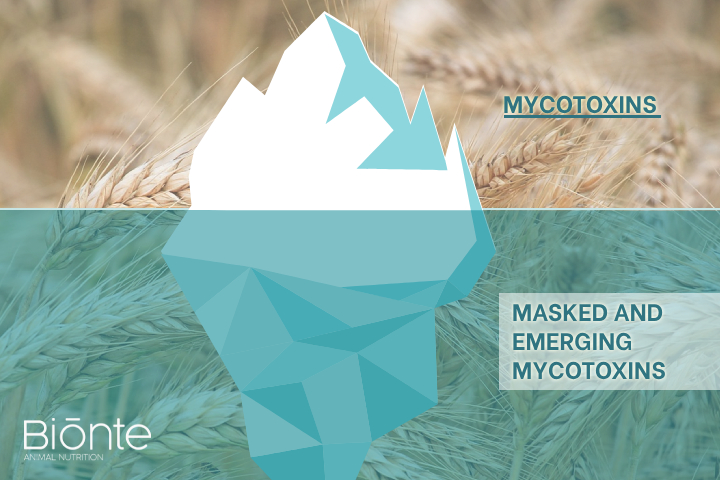
In the 1980s, it was observed that mycotoxin-associated diseases in animals did not correspond to the concentrations of mycotoxins detected in feed analyses. In other words, the severity of the clinical signs was greater than that suggested by the measured levels. This discrepancy indicated that the mycotoxins quantified using conventional analytical methods were not the sole source of exposure. This finding paved the way for the concept of modified and emerging mycotoxins: altered or poorly characterised forms of mycotoxins that are not routinely detected (Kovaslky et al., 2016).
Modified mycotoxins are derivatives of mycotoxins produced by fungi that have undergone changes in their original structure. These modifications may occur through chemical or biological reactions (Freire et al., 2018).
Plants can generate modified mycotoxins as part of their defence mechanisms when infected by mycotoxin-producing fungi. Similarly, animals can metabolise mycotoxins present in feed and convert them into new modified forms.
The most frequently detected modified mycotoxins belong to the fusariotoxin family, including deoxynivalenol (DON), zearalenone (ZEN), HT-2 toxin, nivalenol (NIV) and fumonisins (FBs). These compounds are commonly conjugated with glucose or sulphate groups (e.g. DON-3-G, NIV-3-GlcA, HT-2-Glc, ZEN-14-G, ZEN-14-S). In some cases, these conjugations may be reversible; that is, a parent mycotoxin may be modified, and a modified mycotoxin may subsequently undergo deconjugation, releasing the parent compound (Nešić et al., 2023).
In addition, modified mycotoxins represent a significant analytical challenge, as they are not easily detectable. This is due both to their structural similarity to parent mycotoxins and to the lack of validated analytical methodologies for their determination in routine analyses.
The term emerging mycotoxins refers to a relatively new group of chemically diverse toxins that are not routinely monitored and for which no regulatory limits or legislative recommendations exist. These compounds are mainly secondary metabolites produced by fungi of the genus Fusarium, including enniatins (ENN), beauveracin (BEA), moniliformin (MON) and fusaproliferin (FUS) (Gruber-Dorninger et al., 2017).
Similarly to modified mycotoxins, the analytical complexity of emerging mycotoxins hampers both their control and investigation. Although new emerging and modified mycotoxins continue to be identified, studies specifically focused on these compounds remain limited. This is mainly due to constraints in the development of analytical methods for their quantification, which are largely associated with the lack of analytical standards and certified reference materials. At present, their determination therefore represents a significant analytical challenge, particularly in view of their high occurrence in raw materials and feed.
In addition, climate change and rising cereal prices are factors that may favour the production of these mycotoxins. On the one hand, fungi may alter their behaviour and, consequently, their mycotoxin production in order to adapt to new environmental conditions. On the other hand, increased cereal prices have driven the use of cereal by-products, which may lead to higher levels of mycotoxin contamination in animal feed.
At present, the toxicological properties of these mycotoxins are under investigation to assess the risks they pose to animal production (Berthiller, 2013; Szulc et al., 2021).
Regarding modified mycotoxins, their toxicity is often comparable to that of the parent mycotoxin. However, it should be noted that digestive processes in the gastrointestinal tract, as well as metabolism in the bloodstream or in organs such as the liver, may result in higher-than-expected toxicity. In this context, species-specific physiological characteristics play a key role in determining the toxicological impact of modified mycotoxins. At present, the available data on this topic remain limited.
As observed for some of the most prevalent mycotoxins, emerging mycotoxins have been shown in vitro to induce oxidative stress. In vivo studies have also reported alterations in immune function and damage to the intestinal barrier; however, additional data are still required to substantiate and fully characterise the effects of these mycotoxins.
Conclusion
Recognition of the existence and toxicity of modified and emerging mycotoxins is essential, and further research in this field is needed. Despite current limitations in toxicological data and analytical methods, their global occurrence is significant and should not be underestimated.


A empresa que fornece soluções eficazes contra as micotoxinas.
Calle México, 33. Polígono Industrial Tecnoparc.
43204 Reus (Tarragona) - España
Dados de contato
E-mail: bionte@bionte.com
Telefone: +34 977 317 111