Introdução
Na indústria avícola, o rápido crescimento dos frangos de corte implica um elevado consumo de alimento, o que aumenta sua exposição às micotoxinas. Além disso, os frangos mais jovens apresentam um fígado pouco desenvolvido, assim como um sistema imune imaturo, o que limita a sua capacidade de metabolização destas substâncias e os torna indivíduos muito suscetíveis a estes compostos (Gómez-Verduzco et al., 2024).
As micotoxinas geram um importante efeito imunossupressor nas aves. Elas atuam inibindo a atividade enzimática, o que diminui a síntese proteica e, consequentemente, reduz a resposta imune.
Embora a toxicidade gerada pelas micotoxinas esteja relacionada ao aumento do tamanho de alguns órgãos, como o fígado, estas substâncias também são capazes de reduzir o tamanho de órgãos como o timo, o baço ou a bolsa de Fabricius, gerando atrofia e alterando, com isso, o sistema linfoide e a resposta imune nas aves (Khan et al., 2024; Awais et al., 2022; Gómez-Verduzco et al., 2024).
Do ponto de vista econômico, a imunossupressão é um dos efeitos mais significativos das micotoxinas. Este efeito representa uma maior suscetibilidade a doenças infecciosas, facilita a reativação de infecções crônicas nos animais e aumenta o uso de medicamentos e a redução da eficácia dos programas de vacinação.
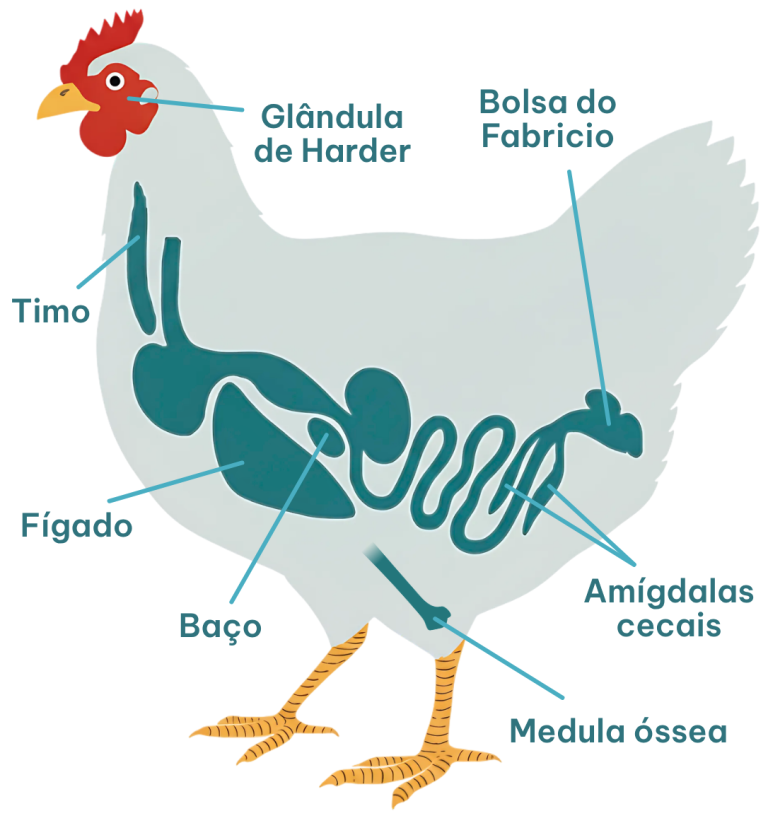
Imagem 1. Esquema do sistema imune das aves.
Doenças respiratórias e micotoxinas
As doenças respiratórias são uma das principais causas de morbidade e mortalidade na indústria de aves de produção. O efeito imunossupressor associado ao consumo de micotoxinas nas aves implica tanto um aumento na prevalência desse tipo de doenças, como um maior impacto nas granjas, devido à falta de resposta imune nos animais.
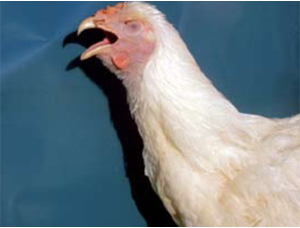
Imagem 2. Ave com dificuldade respiratória, bico aberto, com a cabeça e pescoço estendidos.
Por outro lado, a presença de micotoxinas na ração está associada à redução de efetividade dos planos de vacinação contra doenças respiratórias, como o vírus da doença de Newcastle (NDV), a bronquite infecciosa (IBV) ou a influenza aviária, entre outras, cuja prevenção é crucial para a manutenção do status sanitário nos sistemas de produção avícola (Kulcsár et al., 2023; Abdelrahman et al., 2022).
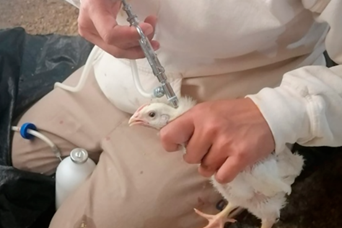
Imagem 3. Vacinação de frangos de corte contra Influenza aviária.
A seguir, apresenta-se uma tabela que resume os efeitos do deoxinivalenol (DON) sobre os títulos de anticorpos gerados pelas vacinas contra o NDV e a IBV. Esta tabela fornece uma visão comparativa de como a presença de DON na ração pode influenciar a eficácia das vacinas, alterando a resposta imune das aves e, potencialmente, comprometendo a proteção contra esses patógenos.
| Deoxinivalenol (mg/kg de dieta) | Aves (espécie e sexo) | Duração da exposição (dias) | Título de anticorpos | Referência |
|---|---|---|---|---|
| Até 12,21 mg/kg de dieta | Frangos de corte (machos) | 35 | NDV aumentou nas semanas 2 e 4; NDV diminuiu na semana 5; IBV diminuiu na semana 5; IBV não foi afetado nas semanas 2, 4 e 5 | Yunus et al. (2012) |
| 10 mg/kg de dieta | Frangos de corte (machos) | 35 | IBV diminuiu na semana 5 | Ghareeb et al. (2012) |
| 3,5–14 mg/kg de dieta | Frangos de corte (machos) | 35 | NDV diminuiu | Dänicke et al. (2003) |
| 4,7–8,3 mg/kg de dieta | Frangos de corte (machos) | 14 | IBV não afetado | Swamy et al. (2002) |
| 12,6 mg/kg de dieta | Matrizes de frangos de corte | 84 | IBV diminuiu; NDV não afetado | Yegani et al. (2006) |
| 18 mg/kg de dieta | Pintos White Leghorn | 72 | NDV não afetado | Harvey et al. (1991) |
| 12,3 mg/kg de dieta | Galinhas poedeiras | 112 | NDV diminuiu | Dänicke et al. (2001) |
Tabela 1. Efeitos do DON sobre os títulos de anticorpos gerados pelas vacinas comuns em aves. NDV, Vírus da Doença de Newcastle; IBV, Vírus da Bronquite Infecciosa (Awad et al., 2013).
Conclusão
Em conclusão, as micotoxinas representam uma ameaça importante para a produção avícola, pois aumentam o impacto das doenças respiratórias, dificultando seu controle por meio dos programas de vacinação estabelecidos. Devemos estar cientes de sua importância e agir de forma adequada, a fim de evitar as enormes repercussões negativas que podem causar na produção animal e os riscos que elas representam para a segurança dos alimentos.