
For many years, the effects of mycotoxins on human and animal health have been studied and described on a toxin-by-toxin basis. Limited awareness of the simultaneous contamination of feed with multiple mycotoxins, and their potential combined or interactive effects, has led to an underestimation of the toxicity of these compounds (Viegas et al., 2011).
In animal production, the clinical manifestations of mycotoxicosis can rarely be explained by exposure to low levels of a single mycotoxin. Notably, the co-occurrence of mycotoxins may result in effects up to twice as great as those observed when they occur individually.
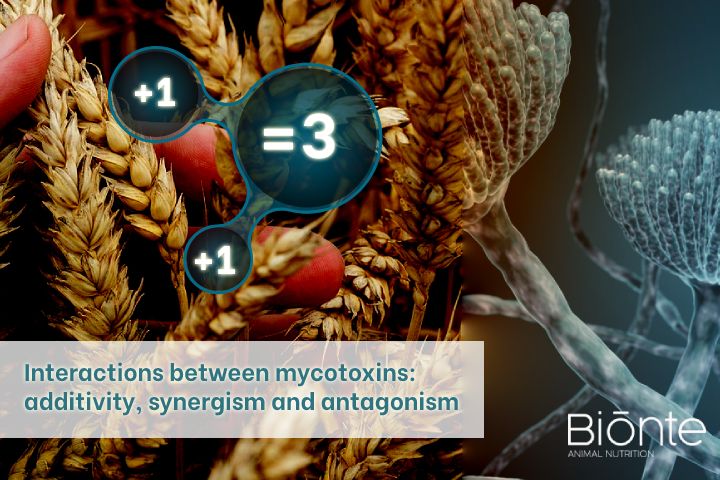
The co-occurrence of multiple mycotoxins gives rise to different types of interactions, which may be additive, antagonistic or synergistic (Greco et al., 2014). The nature of these interactions varies according to animal species, sex, age, mycotoxin dose, duration of exposure, nutritional status, and route of exposure (Gruber-Dorninger et al., 2019).
Additivity refers to an interaction in which the combined effect of multiple mycotoxins equals the sum of their individual effects. By contrast, when a mycotoxin combination produces only the effect of the most toxic compound, with no contribution from the additional mycotoxin, the interaction is described as “less than additive” (Smith et al., 2016).
To date, additive interactions have been documented for various mycotoxin combinations, including aflatoxin B1 (AFB1) with ochratoxin A (OTA), AFB1 with T-2 toxin (T-2), AFB1 with fumonisin B1 (FB1), OTA with T-2, deoxynivalenol (DON) with FB1, moniliformin (MON) with FB1, MON with DON, FB1 with diacetoxyscirpenol, and FB1 with T-2 (Gimeno et al., 2011).
Antagonism refers to an interaction in which the combined effect of multiple mycotoxins is less than the sum of their individual effects (Smith et al., 2016). In other words, an antagonistic effect is observed when the toxicity of one compound mitigates the toxicity of another compound (Ruiz et al., 2011). For example, the combination of DON and zearalenone (ZEN) has been reported to exert antagonistic effects on immune function in pigs, as well as on health and hepatic metabolism in mice (Gruber-Dorninger et al., 2019).
Synergism between mycotoxins is defined as a toxic effect produced by the combination of multiple mycotoxins at specific concentrations, which is absent when the mycotoxins occur individually (Gimeno et al., 2011).
In other words, synergism occurs when the combined effect exceeds the sum of the individual effects of the mycotoxins.
When one or both mycotoxins do not induce an effect, but their combination produces a significant effect, this is referred to as potentiation, although this term is rarely used (Smith et al., 2016). Synergism enhances the toxic effects of mycotoxins. Examples of synergistic interactions include those between aflatoxins and OTA, as well as aflatoxins and T-2, among others (Greco et al., 2014).
Among Fusarium-derived mycotoxins, most reported interactions are additive or synergistic, with effects observed on mortality, animal growth, and feed intake. Several studies have also described synergistic interactions between DON and fusaric acid, DON and FB1, and even between diacetoxyscirpenol and aflatoxins (Pedrosa, 2010).
Some synergistic interactions reported in the literature and their effects on production performance are presented in the following table (Gimeno et al., 2011):
| Combination of mycotoxins | Described effect |
|---|---|
| DON + AFB1 | Simultaneous exposure to these toxins has been associated with increased severity of clinical signs in chickens, including reduced weight gain, decreased growth rate, and anaemia. In pigs, co-exposure commonly results in vomiting, feed refusal, and reduced weight gain. |
| T-2 + AFB1 | The synergistic interaction between aflatoxins and T-2 is of relevance in poultry, as it is associated with increased prevalence and severity (Greco et al., 2014). Studies in chickens have shown that the toxic effects of T-2 and AFB1 are exacerbated when they occur simultaneously. Common findings include oral lesions, reduced live weight gain, decreased serum enzyme activity, and reduced protein levels. |
| T-2 + OTA | The combination of these two mycotoxins markedly affects animal performance. In chickens, the combined action of both toxins leads to reduced weight gain, decreased protein levels, and impaired nutritional efficiency. In pigs, co-contamination is associated with a significant reduction in live weight gain, together with a decrease in relative liver weight. |
| T-2 + DON | In chickens, co-contamination with these toxins significantly affects weight gain. Additionally, the incidence of T-2-associated oral lesions increases in the presence of DON. |
| Diacetoxyscirpenol + DON | The combination of these mycotoxins increases the relative weights of the liver, gizzard, and kidneys in chickens. Furthermore, severe nephropathy and oral lesions are observed. |
| Diacetoxyscirpenol + AFB1 | In pigs, the combined exposure to these toxins has been reported to increase the relative weights of the liver and spleen. It is also associated with reduced iron uptake, lower serum nitrogen levels, and the exacerbation of pathological alterations. |
| FB1 + T-2 | In chickens, co-contamination with these toxins has been associated with mortality rates of up to 15%. Additionally, the relative weights of the liver and kidneys, as well as cholesterol levels, increase. |
| DON + ZEN | In pigs, the combination of these two toxins leads to feed refusal, vomiting, and bloody faeces. In hens, their combined effect causes reduced egg production and lesions in the mouth and crop. |
| FB1 + AFB1 | In turkeys, the combination of these two toxins significantly decreases serum levels of total protein, albumin, and cholesterol. Furthermore, feed conversion is significantly impaired. |
The presence of multiple mycotoxins in the diet poses a real threat to animal and human health. Each combination of mycotoxins may produce distinct toxic effects, even when present at apparently low concentrations (Smith et al., 2016).
A major limitation is that many studies on mycotoxin combinations in animal nutrition are conducted in vitro, primarily using cell models. At the cellular level, toxic effects may vary depending on several factors:
In this way, the lack of in vivo studies enabling a more precise understanding of the real effects in whole organisms becomes evident. The diversity of mycotoxin interactions is broad and, in most cases, additive or synergistic effects are observed. However, owing to the complexity of these combinations, predicting their joint toxicity remains extremely difficult.
Conclusion
The findings highlight the importance of further research on mycotoxin interactions and chronic exposure to subtoxic concentrations in multi-contaminated feed, as this approach more accurately reflects the real conditions affecting animal production.


The company that provides effective solutions against mycotoxins.
Calle México, 33. Polígono Industrial Tecnoparc.
43204 Reus (Tarragona) - España
Contact information
E-mail: bionte@bionte.com
Telephone: +34 977 317 111