Introdução
Da mesma forma que as micotoxinas são altamente tóxicas para os animais, esses compostos representam uma ameaça para a saúde humana. Sua elevada toxicidade é especialmente perigosa para crianças, gestantes e pessoas com sistemas imunológicos debilitados, o que torna seu controle uma prioridade para a segurança alimentar.
Existem diferentes vias de exposição. Sabe-se que, quando essas toxinas são ingeridas diretamente pelo consumidor, dão origem à micotoxicose primária. Já em outros casos, o consumidor pode sofrer essa intoxicação devido ao consumo de produtos de origem animal contaminados (por exemplo, carne, leite ou ovos), o que é denominado micotoxicose secundária (Imagem 1).
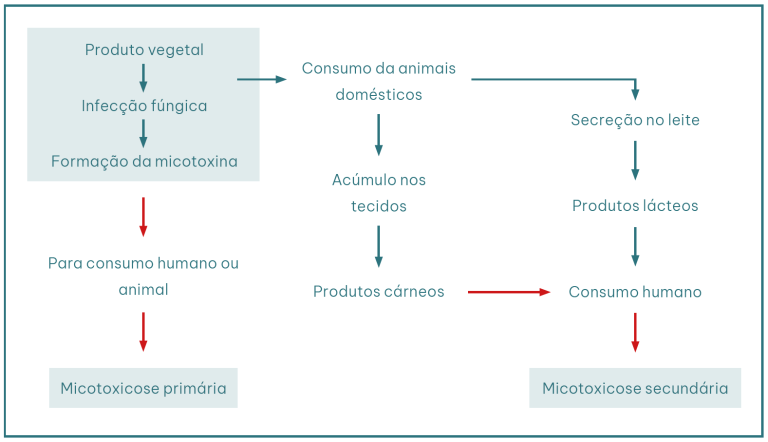
Imagem 1. Diferenças entre micotoxicose primária e secundária (adaptada de Bhat, 1997 e de Sanchís et al., 2004).
Uma vez ingeridas, essas micotoxinas passam pelos processos de toxicocinética, que incluem:
- Absorção
- Distribuição
- Biotransformação
- Excreção
A importância desses processos, no caso dos animais, reside no fato de que também pode ocorrer a transferência de metabólitos das micotoxinas para produtos de origem animal.
Essa passagem, na qual esses compostos indesejados chegam aos tecidos ou produtos animais comestíveis, é comumente conhecida como carry-over (Völkel et al., 2011).
As micotoxinas que receberam maior atenção devido à transferência da ração para os produtos de origem animal são as aflatoxinas (AFB1 e AFM1), a ocratoxina A (OTA), a zearalenona (ZEA), as fumonisinas (FBs), a toxina T-2 (T-2) e a toxina HT-2 (HT-2) (Tabela 1; Tolosa et al., 2021).
| Micotoxinas | Matriz | Fungos |
|---|---|---|
| AFB1, AFB2, AFG1, AFG2 AFM1 | Milho, amendoim, especiarias, frutas secas Leite, ovos, queijo | Aspergillus flavus, Aspergillus parasiticus |
| OTA | Trigo, cevada, milho, café, vinho, cerveja | Aspergillus ochraceus, Aspergillus carbonarius, Aspergillus niger, Penicillium verrucosum |
| DON (deoxinivalenol) | Trigo, cevada, milho | Fusarium graminearum, Fusarium culmorum |
| T-2, HT-2 | Trigo, milho, cevada, centeio | Fusarium sporotrichioides, Fusarium poae |
| ZEA | Trigo, milho | Fusarium graminearum, Fusarium culmorum, Fusarium crookwellense |
| FBs | Trigo | Fusarium moniliforme, Fusarium proliferatum |
Tabela 1. Principais micotoxinas em alimentos e rações para consumo humano, animal e seus fungos produtores (Tolosa et al., 2021).
Micotoxinas nos produtos de origem animal
A presença de micotoxinas nos produtos de origem animal, juntamente com agentes virais e bacterianos, representa uma das maiores ameaças à segurança, higiene e qualidade dos alimentos destinados ao consumo humano. A seguir, enumeram-se as matrizes que podem sofrer contaminação por esses compostos.
Ovos
A ingestão de rações contaminadas com micotoxinas por parte das galinhas poedeiras causa vários problemas de saúde, acarretando grandes perdas econômicas em termos de qualidade e quantidade de ovos.
As micotoxinas comuns encontradas nos ovos são as aflatoxinas, OTA, ZEA e fumonisinas (Greco et al., 2014; Jia et al., 2016). Além disso, alguns autores demonstraram a presença de enniatina B1 (ENN B1) nesses produtos de consumo humano (Jestoi, 2008).
Carne e derivados
Assim como o leite, a carne e seus derivados podem apresentar contaminação por carry-over. Nesse sentido, os estudos realizados para avaliar a presença de micotoxinas nesta categoria de produtos indicam que, em carne fresca e órgãos animais, as toxinas mais prevalentes são as aflatoxinas, OTA, fumonisinas e ZEA (Meucci et al., 2019; Hort et al., 2020). Em contrapartida, as micotoxinas mais frequentemente relatadas em produtos cárneos curados e fermentados são a OTA e as aflatoxinas.
A contaminação por aflatoxinas em carne e derivados tem sido amplamente estudada, especialmente em suínos e aves, já que essas espécies são consideradas entre as mais suscetíveis aos efeitos das micotoxinas. Essa maior suscetibilidade está associada à estrutura do sistema digestivo simples e não especializado dessas espécies, que permite que muitas dessas toxinas sejam absorvidas em sua forma ativa, gerando elevada toxicidade.
Por outro lado, os níveis de carry-over descritos em ruminantes costumam ser inferiores aos encontrados em monogástricos, graças aos processos de desintoxicação que ocorrem tanto no rúmen quanto em nível hepático (Tolosa et al., 2021).
No entanto, uma maior suscetibilidade biológica não implica necessariamente concentrações elevadas nos produtos comestíveis. Em suínos, as concentrações de aflatoxinas detectadas em produtos cárneos são geralmente baixas, devido ao seu metabolismo hepático. Em aves, descreveu-se a metabolização dessas micotoxinas em aflatoxicol no fígado, metabólito que não representa uma ameaça para a saúde humana (Tolosa et al., 2021). Cabe destacar que a OTA constitui uma das micotoxinas mais importantes em suínos, pois é frequentemente detectada em tecidos comestíveis e subprodutos suínos (Stoev et al., 2002).
Quanto às demais micotoxinas, a ZEA e seu metabólito α-zearalenol (α-ZEL) foram detectados em fígados e na carne de suínos (Pleadin et al., 2015). Além disso, é necessário destacar a presença de FB1 e FB2 em embutidos e fígados de suínos (Zhao et al., 2015).
Em relação à presença de micotoxinas emergentes na carne, estas foram detectadas em tecidos de perus e frangos, sendo a enniatina (ENN) e seus metabólitos os principais encontrados no soro e no fígado de frangos de corte (Křížová et al., 2021).
Leite
Um dos casos mais estudados de carry-over é, talvez, o do metabólito hidroxilado AFM1, que provém da AFB1 e é encontrado com muita frequência no leite e em seus derivados (Gonçalves et al., 2020; Tolosa et al., 2021). Foram amplamente demonstrados os efeitos tóxicos das aflatoxinas e de seus metabólitos, que afetam tanto as espécies animais quanto os seres humanos, destacando-se seu efeito carcinogênico. Além disso, um ponto importante em relação à presença de AFM1 no leite é sua elevada termoestabilidade, uma vez que este metabólito se mostra altamente resistente a tratamentos térmicos como UHT (Ultra High Temperature) ou a pasteurização (Mohamadi et al., 2010).
Ainda sobre os metabólitos encontrados no leite e em seus derivados, embora em menor escala, foi detectada a forma da OTA convertida pela microbiota ruminal, conhecida como OTα (Hashimoto et al., 2016).
Foi descrita a presença, no leite e em seus derivados, de outras micotoxinas, como fumonisinas, ZEA e DON (Becker-Algeri et al., 2016). Em relação às fumonisinas, os estudos realizados indicam que essa micotoxina e seus metabólitos apresentam baixa transferência (Flores-Flores et al., 2015).
Da mesma forma, a ZEA foi detectada tanto em leite fresco quanto em leite em pó, embora não represente um perigo para a saúde humana, já que as concentrações detectadas foram muito baixas (Flores-Flores et al., 2015; Huang et al., 2014). No que diz respeito ao DON, no leite e em seus derivados foi detectada apenas sua forma menos tóxica, o deepoxi-DON (DOM-1) (Tolosa et al., 2021).
Cabe destacar que, nos últimos anos, foram detectadas no leite micotoxinas emergentes e modificadas, como a beauvericina (BEA) e as enniatinas. Por exemplo, foram detectados baixos níveis de enniatinas em amostras de leite de ovelhas (Piątkowska et al., 2018). Da mesma forma, o carry-over dessas micotoxinas foi confirmado em estudos de leite humano. No entanto, diferentemente de outras micotoxinas, essas não foram detectadas em leite de vaca (Křížová et al., 2021).
Peixe
O carry-over de micotoxinas na aquicultura não é tão estudado quanto o observado em outros produtos. No entanto, foram estudadas as principais micotoxinas de interesse para o setor, e sabe-se que os órgãos dos peixes que apresentam uma concentração de micotoxinas são o fígado, os rins e os músculos comestíveis (Tolosa et al., 2021).
Por exemplo, no salmão-do-Atlântico (Salmo salar), o carry-over de DON para os músculos e rins é muito significativo em comparação com o observado na dourada (Sparus aurata), onde é nulo (Pietsch et al., 2014; Nácher-Mestre et al., 2015). Por outro lado, o mesmo Salmo salar não apresenta carry-over de ZEA nem de seus metabólitos nos músculos, mas a truta arco-íris (Oncorhynchus mykiss) acumula essa micotoxina tanto no intestino quanto no fígado e nos ovários (Nácher-Mestre et al., 2020).
Em relação às micotoxinas emergentes, diversos estudos ressaltaram a presença de enniatinas em peixes de cultivo, como, por exemplo o robalo (Dicentrarchus labrax) e a dourada (Sparus aurata), particularmente nos músculos e no fígado (Tolosa et al., 2014).
Conclusão
O carry-over das micotoxinas em produtos de origem animal representa um problema importante que pode afetar a segurança e a qualidade dos alimentos e, consequentemente, a saúde humana e animal. A determinação de níveis de exposição seguros às micotoxinas, juntamente com a implementação de boas práticas agrícolas e de fabricação de rações, são fatores-chave para reduzir e prevenir a contaminação por micotoxinas. Dessa forma, pode-se prevenir a transferência das micotoxinas e de seus metabólitos secundários para os produtos de origem animal e proteger a saúde do consumidor.