INTRODUCTION AND OBJECTIVE
Swine are recognized as one of the most susceptible species to the toxic effects of mycotoxins. Zearalenone (ZEN) is of concern due to its estrogenic activity. Sows are especially sensitive to this compound, which can disrupt reproductive physiology, leading to impaired fertility and decreased reproductive efficiency (Wu et al., 2021). These reproductive disorders not only compromise animal health but also result in significant economic losses for the porcine industry due to reduced litter sizes and premature culling of breeding stock.
The aim of this study was to evaluate the efficacy of an anti-mycotoxin agent (AMA) that included adsorbing material, turmeric (curcumin) extract, milk thistle (silymarin) extract, and yeast-derived components, in mitigating the adverse effects of ZEN in prepubertal gilts, acting through adsorption, bioprotection, and postbiotic effect.
MATERIALS AND METHODS
SUMMARY/KEY POINTS
Zearalenone (ZEN) at 1.2 ppm triggers severe reproductive toxicity in prepubertal gilts.
The tested anti-mycotoxin agent acts through a synergistic blend of adsorption, bioprotection (curcumin and silymarin), and postbiotic effects to neutralize ZEN-induced estrogenicity.
RESULTS AND DISCUSSION
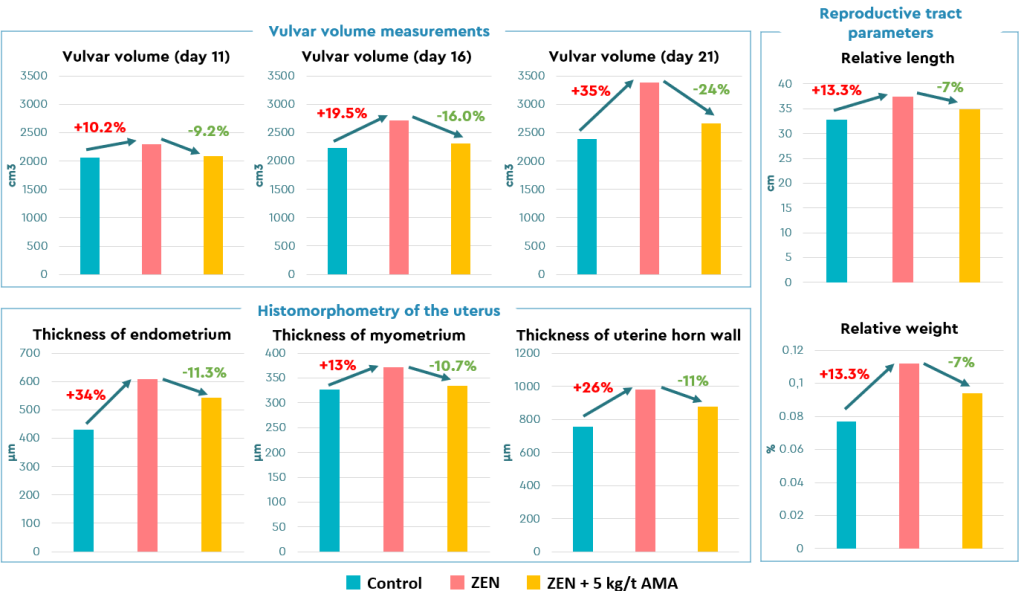
ZEN exposure induced estrogenic and hypertrophic effects in prepubertal gilts, increasing volume (+1006.63 cm³), reproductive tract length (+4.69 cm), and relative tract weight (+0.04%). The AMA significantly alleviated these effects, reducing vulvar volume (p = 0.0003) and relative tract weight (–0.02 %, p = 0.0016); while the decrease in tract length (–2.53 cm) was not statistically significant. Additionally, ZEN caused uterine hypertrophy, increasing endometrium (+176.66 µm), myometrium (+45.55 µm), and total wall thickness (+225.07 µm). The AMA attenuated these alterations: -65.49 µm, -38.08 µm, and -103.90 µm, respectively. Direct comparison between control and ZEN-exposed animals receiving anti-mycotoxin treatment showed complete restoration of macroscopic estrogenic indicators (vulvar swelling, tract length) alongside partial mitigation of microscopic tissue changes.
CONCLUSION
ZEN induced pronounced estrogenic alterations in prepubertal gilts, confirming the expected estrogenic activity. The AMA at 5kg/ton significantly mitigated these effects, confirming its neutralizing efficacy against ZEN-induced reproductive toxicity.
ACKNOWLEDGEMENTS AND REFERENCES
Wu, F., Cui, J., Yang, X., Liu, S., Han, S., & Chen, B. (2021). Effects of zearalenone on genital organ development, serum immunoglobulin, antioxidant capacity, sex hormones and liver function of prepubertal gilts. Toxicon, 189, 39–44. https://doi.org/10.1016/j.toxicon.2020.11.005
This work was funded by the Centre for the Development of Technology and Innovation (CDTI) of the Spanish Ministry of Science, Innovation and Universities (Project IDI-20230474).
This work was carried out in collaboration with SAMITEC.