Introdução
Os fungos do gênero Aspergillus são microrganismos amplamente distribuídos no ambiente, estando presentes no ar, no solo e na matéria orgânica em decomposição, que incluem mais de 250 espécies. Embora alguns deles tenham aplicações industriais, como a produção de alimentos fermentados ou enzimas, outros representam uma ameaça significativa para a saúde humana, animal e vegetal, devido à produção de micotoxinas (Klich, 2007).
Estes fungos são os principais produtores de aflatoxinas, micotoxinas altamente tóxicas que se geram sob certas condições ambientais, e que se relacionam com múltiplos problemas na cadeia alimentar global. Com as alterações climáticas a intensificarem as condições favoráveis para a proliferação dos fungos do género Aspergillus, a regulação e o controlo destas toxinas tornam-se cada vez mais cruciais.
Características morfológicas
Os fungos Aspergillus são fungos filamentosos caracterizados pela sua capacidade de se reproduzirem de forma assexuada através da formação de conídios. A sua estrutura morfológica distingue-se por uma arquitetura especializada que facilita a dispersão eficiente dos seus esporos. As diferentes partes encontram-se detalhadas na Figura 1.
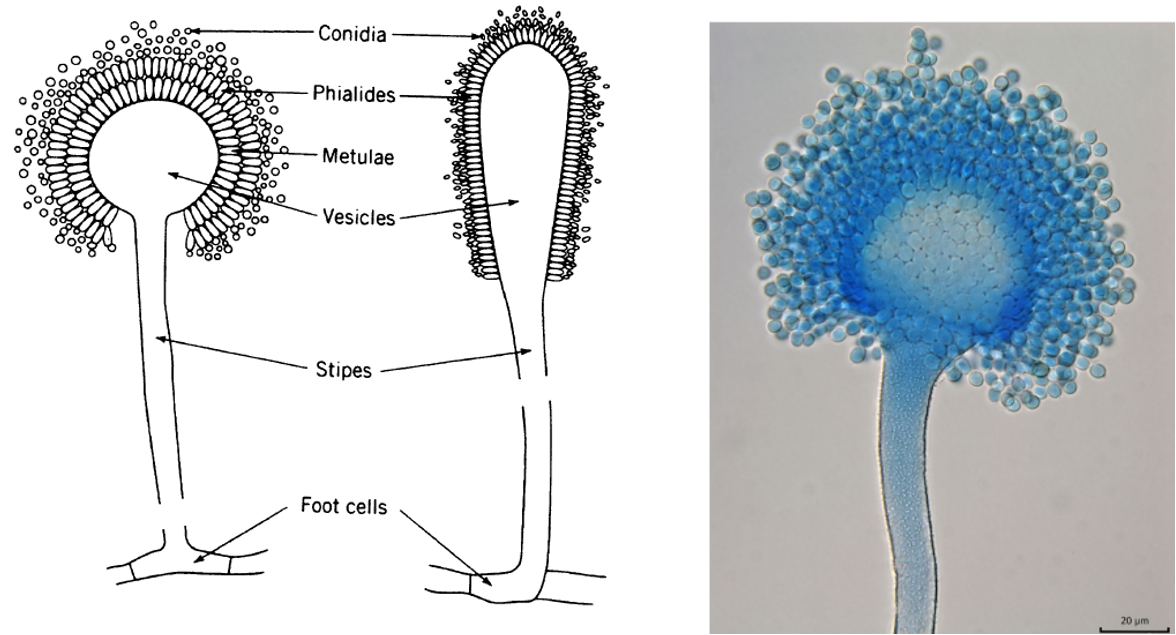
Figura 1. A) Imagem de microscopia de Aspergillus (Pickova et al., 2021).
B) Morfología Aspergillus (Klich, 2009).
Conidióforos:
Os conidióforos são estruturas alongadas e eretas que emergem de células-pé (células basais). Essas estruturas atuam como suporte para os demais componentes do aparelho aparelho conidial e apresentam um estipe rígido, liso ou rugoso, dependendo da espécie. O seu comprimento e espessura podem variar entre espécies, mas termina sempre em uma vesícula característica.
Vesícula:
A vesícula é uma estrutura globosa ou clavada localizada no ápice do conidióforo. Nessa estrutura insere-se as fiálides e, em algumas espécies, também as métulas. Seu tamanho e forma são características taxonómicas importantes para a identificação das espécies de Aspergillus.
Métulas e Fiálides:
- Métulas: São células alongadas e cônicas dispostas radialmente ao redor da vesícula em espécies com uma organização bisseriada. Estas estruturas servem como base para as fiálides.
- Fiálides: São estruturas especializadas que se originam diretamente na vesícula (em espécies unisseriadas) ou das métulas (em espécies bisseriadas). As fiálides são responsáveis pela produção de conídios por meio de um processo contínuo de conidiogênese.
Conídios
Os conídios são estruturas assexuadas esféricas ou subesféricas que se dispõem em cadeias basípetas (os esporos mais jovens formam-se na base da cadeia). Apresentam uma superfície lisa ou rugosa, dependendo da espécie, e contêm melanina, o que lhes confere resistência perante condições ambientais adversas. São as unidades de dispersão do fungo.
Células basais ou pé:
As Células basais também denominadas pé, constituem a base do conidióforo e são responsáveis pela fixação da estrutura ao substrato. Sua forma e tamanho contribuem para a sustentação do aparelho conidial (Klich, 2007).
As micotoxinas produzidas por Aspergillus
Dentro do gênero Aspergillus, existem espécies altamente produtoras de micotoxinas, entre as quais se destacam o Aspergillus flavus e o Aspergillus parasiticus. Estas toxinas não têm uma função clara no crescimento ou desenvolvimento do fungo, o que as classifica como metabolitos secundários. Acredita-se que a sua síntese ocorre em determinadas condições, com fins de defesa ou proteção, como resposta a condições de estresse ambiental (Suárez et al., 2013). Também foi sugerido que estas toxinas auxiliam os fungos a colonizar tecidos vegetais debilitados ou danificados, favorecendo a sua sobrevivência e persistência no ambiente (Varga et al., 2003).
Entre as micotoxinas mais importantes que o género Aspergillus pode produzir destancan-se as aflatoxinas, consideradas potentes carcinógenos, capaz de contaminar culturas como o milho, o trigo e o arroz.
Estas micotoxinas são as que apresentam uma maior regulação, tendo sido relacionadas historicamente com grandes contaminações que resultaram em inúmeras mortes. Um dos primeiros casos ocorreu em 1961, numa quinta avícola em Londres, onde um total de 100.000 perus morreram devido à denominada doença “X” dos perus, após terem sido alimentados com farelo de amendoim brasileiro contaminado por aflatoxinas (Blount et al., 1961).
Além das aflatoxinas, foi demonstrado que o gênero Aspergillus é capaz de gerar outras micotoxinas, tal como se pode observar na tabela seguinte (Ráduly et al., 2020).
| Espécie de Aspergillus | Aflatoxinas | Ocratoxina | Citrinina | Patulina | Ácido ciclopiazõnico | Aflatrem | Terrein |
|---|---|---|---|---|---|---|---|
| A. alliaceus | X | ||||||
| A. arachidicola | X | ||||||
| A. arachidicola sp. nov. | X | ||||||
| A. bombycis | X | ||||||
| A. carbonarius | X | ||||||
| A. flavus | X | X | X | ||||
| A. korhogoensis | X | ||||||
| A. minisclerotigenes sp. nov. | X | X | |||||
| A. niger | X | ||||||
| A. nomius | X | ||||||
| A. novoparasiticus | X | ||||||
| A. ochraceus | X | ||||||
| A. parasiticus | X | ||||||
| A. pseudotamarii | X | ||||||
| A. rambellii | X | ||||||
| A. terreus | X | X | X | X | |||
| A. toxicarius | X |
Tabela 1. Espécies de Aspergillus e micotoxinas produzidas.
Cabe destacar que, dentro das aflatoxinas, destacam-se principalmente as aflatoxinas B1, B2, G1 e G2 nas culturas e a M1 no leite. As nomenclaturas B ou G correspondem à fluorescência que provém da molécula: B = Blue (Azul) e G = Green (Verde) (Figura 2). No caso da aflatoxina M1, trata-se de um metabolito obtido após a biotransformação da aflatoxina B1, que se caracteriza pela sua acumulação no leite.
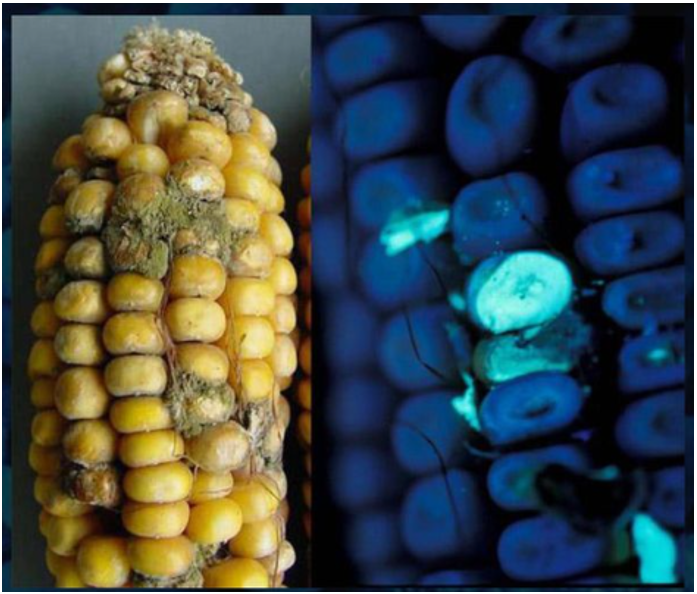
Figura 2. Fluorescência emitida pelas aflatoxinas presentes em milho contaminado com Aspergillus.
Efeitos das micotoxinas nas culturas e na saúde pública
Do ponto de vista agrícola, as infecções por Aspergillus podem provocar perdas econômicas substanciais. Por exemplo, as infeções por Aspergillus flavus podem diminuir o rendimento total das culturas entre 10% e 30% (Ramírez-Camejo et al., 2012). A contaminação das culturas ocorre principalmente em condições quentes e húmidas, o que degrada a qualidade e a quantidade da produção. Além disso, os alimentos contaminados com micotoxinas devem frequentemente ser destruídos, aumentando ainda mais os custos para os produtores.
As micotoxinas de Aspergillus não só afetam a qualidade dos alimentos, como também representam um risco para a saúde animal e humana. No gado, o consumo de alimentos contaminados com micotoxinas pode causar doenças hepáticas, imunossupressão e problemas reprodutivos, o que, por sua vez, afeta o rendimento animal. Nos humanos, a exposição as aflatoxinas tem sido relacionada com doenças graves, como o câncer do fígado, e a sua presença nos alimentos pode causar intoxicações alimentares agudas.
O impacto das alterações climáticas na produção de micotoxinas
As mudanças climáticas estão alterando os padrões de temperatura e precipitação em todo o mundo, criando condições mais favoráveis à proliferação de fungos produtores de micotoxinas, como espécies do gênero Aspergillus. Secas, ondas de calor e alterações nos ciclos de cultivo afetam diretamente a vulnerabilidade das culturas agrícolas, favorecendo a infecção por fungos e, consequentemente, a produção de micotoxinas.
Temperaturas mais elevadas e o aumento da umidade proporcionam condições ideais para o crescimento de Aspergillus e a produção de micotoxinas. Estudos recentes têm demonstrado um aumento nos níveis de aflatoxinas em regiões onde anteriormente essas toxinas não representavam uma preocupação significativa, fenômeno que pode estar relacionado à expansão das zonas climáticas favoráveis ao desenvolvimento desses fungos. Como exemplo, alguns países europeus, tradicionalmente considerados áreas de baixo risco para aflatoxinas, começam a enfrentar problemas associados à contaminação por essas toxinas em decorrência do aumento das temperaturas (Battilani et al., 2016) (Figura 3).
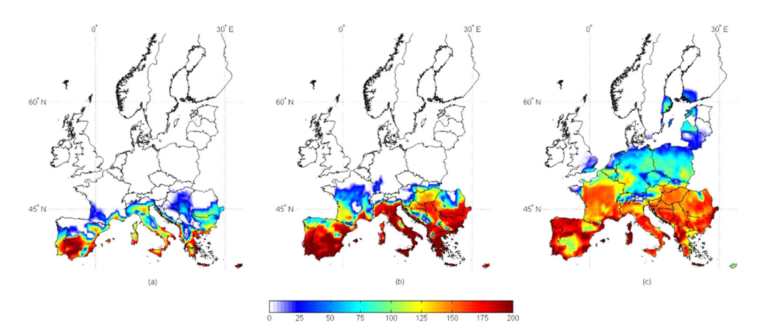
Figura 3. Mapas de risco de contaminação por aflatoxinas em milho durante a colheita sob três diferentes cenários climáticos: condições atuais, aumento de 2 °C e aumento de 5 °C (Battilani et al., 2016).
Vias metabólicas e síntese de aflatoxinas
As aflatoxinas são compostos bisfuranocumarínicos produzidos por mais de 16 espécies de fungos do gênero Aspergillus. As aflatoxinas da série B (AFB1 e AFB2) e da série G (AFG1 e AFG2) são as mais conhecidas devido à sua elevada toxicidade e ampla ocorrência. Sua biossíntese é um processo altamente regulado que envolve três grupos de genes, classificados de acordo com sua função em cada etapa da via metabólica:
- Genes da via inicial: aflA, aflB, aflC, hypC e aflD, responsáveis por iniciar a conversão do hexanoato em ácido norsolorínico.
- Genes da via intermediária: aflG, aflH, aflK, aflV e aflW, responsáveis pela conversão de metabólitos intermediários, como a averufina, em precursores como o acetato de hemiacetal de versiconal (VHA).
- Genes da via final: aflP, aflQ, hypB e outros genes envolvidos nas etapas finais da biossíntese, catalisando as transformações que levam à formação de AFB1, AFB2, AFG1 e AFG2. O gene regulador aflR controla a expressão de diversos genes da via biossintética, enquanto aflS atua como coativador nas etapas iniciais da biossíntese das aflatoxinas.
Em relação às diferenças específicas entre as espécies produtoras e à influência dos fatores ambientais:
- Aspergillus flavus produz predominantemente aflatoxinas do tipo B (AFB1 e AFB2), enquanto Aspergillus parasiticus produz tanto aflatoxinas do tipo B quanto do tipo G.
- A incapacidade do Aspergillus flavus sintetizar aflatoxinas do tipo G está associada a uma deleção nos genes aflF e aflU. No entanto, novas cepas de flavus capazes de produzir as quatro principais aflatoxinas já foram identificadas.
- A produção de aflatoxinas é influenciada por fatores ambientais e pode variar de acordo com a espécie e as condições do ambiente. O conhecimento das vias biossintéticas e dos mecanismos de regulação genética contribui para o desenvolvimento de estratégias destinadas a mitigar a produção de aflatoxinas, além de ampliar a compreensão da diversidade metabólica existente entre as espécies micotoxigênicas.
A seguir, são apresentados os principais aspectos relacionados à biossíntese e à regulação das aflatoxinas em espécies do gênero Aspergillus (Kolawole et al., 2021):
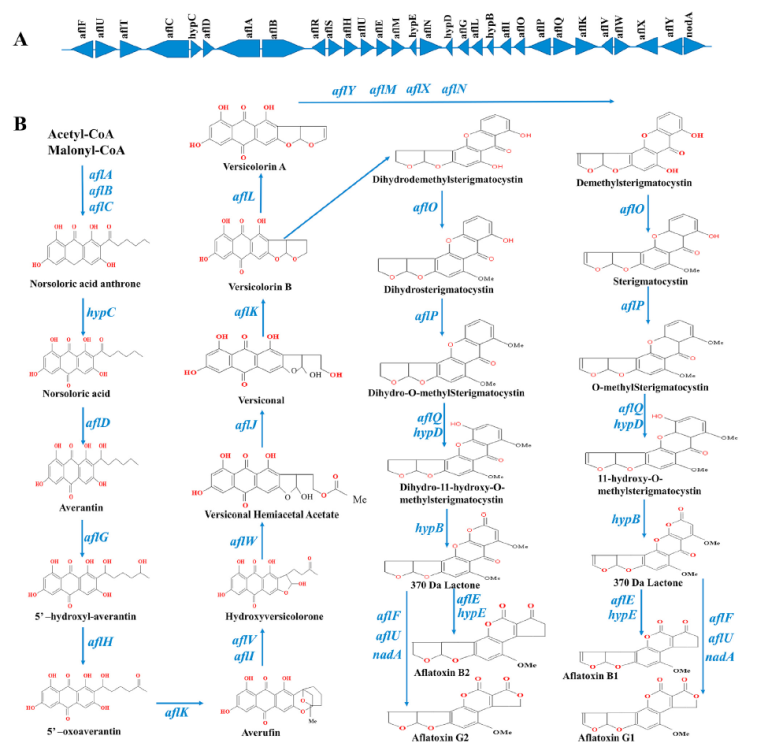
Figura 4. A) Agrupamento dos genes envolvidos na biossíntese de aflatoxinas em espécies de Aspergillus. As setas indicam a direção da transcrição gênica, e os genes reguladores do agrupamento estão destacados em azul.
B) Proposta da via biossintética das aflatoxinas.
(Ehrlich et al., 2004; Skory et al., 1992; Yu et al., 2004)
Regulamentação e estratégias de mitigação de risco
A regulamentação das micotoxinas é fundamental para garantir a segurança dos alimentos e proteger a saúde pública. Em muitos países, existem limites rigorosos para as concentrações máximas permitidas de micotoxinas em alimentos e ingredientes destinados à alimentação animal. Como exemplo, a União Europeia estabeleceu normas específicas para os níveis máximos de aflatoxinas permitidos em produtos agrícolas, tanto para o consumo humano quanto para a alimentação animal.
Devido ao seu elevado potencial tóxico, os limites legais para a aflatoxina B1 (AFB1), considerada uma das aflatoxinas de maior importância toxicológica, são atualmente regulamentados pelo Regulamento (UE) nº 574/2011 da Comissão Europeia, que altera o Anexo I da Diretiva 2002/32/CE.
| Matéria-prima/Ração | Limites legais de aflatoxina B1 (AFB1) na União Europeia, expressos em ppb e referidos a alimentos com 12% de umidade |
|---|---|
| Todas as matérias-primas destinadas à alimentação animal | 20 |
| Rações compostas para bovinos, ovinos e caprinos (exceto animais destinados à produção leiteira, bezerros e cordeiros) | 20 |
| Rações completas para animais leiteiros | 5 |
| Rações completas para bezerros e cordeiros | 10 |
| Rações compostas para suínos e aves de produção (exceto animais jovens) | 20 |
| Outras rações completas | 10 |
| Outras rações complementares | 5 |
Tabela 2. Limites legais estabelecidos para aflatoxina B1 (AFB1).
No entanto, à medida que as mudanças climáticas aumentam a ocorrência de micotoxinas, os atuais marcos regulatórios podem tornar-se insuficientes para enfrentar esse novo cenário. Dessa forma, torna-se necessária uma abordagem global que contemple o monitoramento contínuo das condições ambientais e da presença de micotoxinas nas culturas agrícolas.
Conclusão
Os fungos do gênero Aspergillus e sua capacidade de produzir micotoxinas representam uma ameaça crescente no contexto das mudanças climáticas. O aumento das temperaturas globais está criando condições mais favoráveis à proliferação desses fungos, elevando os riscos para a segurança dos alimentos e para a saúde humana e animal.
Para mitigar esse risco, é fundamental fortalecer os mecanismos regulatórios, incentivar a pesquisa científica e adotar estratégias de adaptação capazes de proteger as culturas agrícolas contra infecções por Aspergillus e reduzir a exposição às micotoxinas. Entre as principais medidas preventivas destacam-se a adoção de boas práticas agrícolas, o manejo adequado durante o armazenamento, a ventilação dos grãos e o controle de pragas. Em conjunto, essas ações podem contribuir significativamente para a redução da ocorrência de micotoxinas em alimentos destinados à alimentação animal.