The toxicity challenge: pesticides and mycotoxins
The safety and quality of raw materials and plant-derived products intended for human and animal consumption can be severely compromised by the presence of various chemical and biological contaminants.
Among the main threats in animal production, mycotoxin contamination stands out. Mycotoxins are low-molecular-weight secondary metabolites synthesized by mycotoxigenic fungi (such as Aspergillus, Penicillium, and Fusarium), which induce acute and chronic mycotoxicosis conditions with a severe impact on livestock health. Likewise, the presence of pesticide residues derived from the use of phytosanitary products in crops represents a significant toxicological risk, associated with neurotoxic, metabolic, and endocrine pathologies (Eze U. A., et al., 2019).
Recent scientific evidence indicates the occurrence of toxicological synergistic effects in animals following co-exposure to mycotoxins and pesticides. In this context, the interaction between both contaminants results in a potentiated effect; that is, the overall toxic response observed is greater than the theoretical sum of the individual effects of each substance on its own. This intensifies the mechanisms of cytotoxicity and oxidative stress at the cellular level, translating into impaired animal health, reduced productive performance, and economic losses (Guo H., et al., 2020).
BIŌNTE® QUIMITŌX®: broad-spectrum mitigation strategy
BIŌNTE® QUIMITŌX® is a high-quality solution formulated for the mitigation of mycotoxin toxicity in animal nutrition through a selective adsorption mechanism. Featuring an optimized matrix of bentonites and sepiolite, its integrated mineral architecture provides broad-spectrum mycotoxin binding while effectively capturing pesticide residues of diverse polarities and molecular structures.
Within this experimental framework, the present in vitro trial, developed by the BIŌNTE technical department in collaboration with the University of Almería and the University of Valencia (Spain), aims to evaluate and validate the adsorption efficiency of BIŌNTE® QUIMITŌX® against five agrochemical substances characterized by high toxicity and prevalence in raw materials, and their potential risk to human and animal health: glyphosate (organophosphonate), carbofuran (carbamate), cypermethrin (pyrethroid), thiram (dithiocarbamate), and atrazine (triazine). Comparative analysis with malathion and deltamethrin was excluded given that both pesticides exhibit high lability under the acidic pH conditions characteristic of the gastrointestinal tract of livestock, undergoing metabolic and chemical degradation processes that reduce their bioavailability (Pergal M.V., et al., 2020; Valencia D., et al., 2020).
Experimental challenge
In order to evaluate the efficacy of BIŌNTE® QUIMITŌX® against highly toxic pesticide residues that threaten the safety of ingredients intended for animal feed, an in vitro trial was carried out in collaboration with the University of Almería and the University of Valencia (Spain). These agrochemicals represent a direct risk to livestock health and the safety of the food chain.
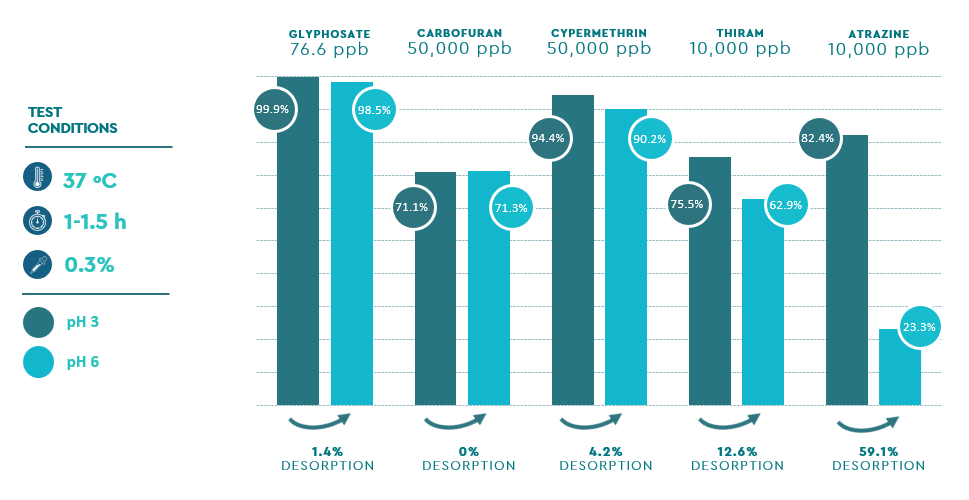
The experimental protocol replicated the physiological conditions of the digestive tract through a pH and temperature-dependent kinetic model. The gastric phase was simulated at a pH 3, while a pH 6 was used to simulate the intestinal phase. Both phases were subjected to continuous agitation in a thermostated bath at 37 °C for a period of 60 to 90 minutes (1–1.5 h). Quantification of the unadsorbed residual analytes was performed using high-performance liquid chromatography coupled with tandem mass spectrometry (HPLC-MS/MS) and high-performance liquid chromatography coupled with a diode-array detector (HPLC-DAD).
Efficacy results
BIŌNTE® QUIMITŌX® demonstrated its ability to mitigate the impact of the active ingredients from prevalent pesticides. The formulation was capable of adsorbing between 70% and 100% of the evaluated pesticides under gastric conditions, showing generally low levels of intestinal desorption (Figure 1).
Conclusion
BIŌNTE® QUIMITŌX® has proven to be effective in adsorbing pesticide residues in animal production. Consequently, its inclusion in diets constitutes an effective strategy for mitigating the negative effects of pesticides, such as metabolic disruption and oxidative stress, as well as preventing synergistic effects with other feed contaminants, such as mycotoxins. This protective action contributes to preserving overall animal health, final product quality, and the productive efficiency of livestock farms.