As fumonisinas são um grupo de micotoxinas produzidas por diversos tipos de fungos, fundamentalmente do género Fusarium, sendo as espécies mais frequentes F. verticillioides e F. proliferatum. Estes contaminantes representam um risco significativo para a segurança alimentar e a saúde pública, já que a sua presença é frequente em culturas básicas como o arroz, o sorgo e, de forma especialmente relevante, o milho e os seus derivados (Zhou et al., 2025; Anumudu et al., 2024; Yli-Mattila e Sundheim, 2022).
Dado que os fungos produtores de fumonisinas crescem num amplo intervalo de temperaturas, mas requerem uma elevada atividade de água, estas toxinas formam-se geralmente antes da colheita ou nas primeiras etapas do armazenamento. Além disso, estas substâncias são termoestáveis, pelo que a sua elevada prevalência nos alimentos compostos para animais é um fator de risco significativo (EFSA, 2025; Schaarschmidt e Fauhl-Hassek, 2021).
Características químicas das fumonisinas
Entre os diferentes tipos de fumonisinas identificados encontra-se a série B. Dentro desta, a fumonisina B1 (FB1), a fumonisina B2 (FB2) e a fumonisina B3 (FB3) têm sido as mais amplamente estudadas, sendo a FB1 a mais destacada pela sua elevada prevalência e toxicidade (EFSA, 2022; Torre-Hernández et al., 2014). Do ponto de vista químico, as fumonisinas são diésteres estruturalmente semelhantes que contêm polióis e ácidos tricarboxílicos de glicerol, que se caraterizam por ser altamente polares e solúveis em água (Figura 1). A sua estrutura assemelha-se à da esfingosina (So) e à da esfinganina (Sa), pelo que se classificam como micotoxinas tipo esfingosina. Estes compostos são componentes-chave da esfingomielina, um lípido essencial das membranas celulares envolvido em processos fundamentais como a proliferação, diferenciação, apoptose, senescência e carcinogénese, além da interação e do reconhecimento célula-célula (Lassallette et al., 2025; Qu et al., 2022).
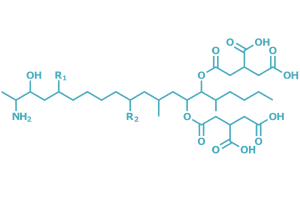
Imagem 1. Estrutura química genérica das fumonisinas do grupo B (Torre-Hernández et al., 2014).
A semelhança estrutural das fumonisinas com So e Sa explica o seu principal mecanismo de toxicidade: a alteração do metabolismo dos esfingolípidos. Neste contexto, o rácio Sa:So é amplamente utilizado como biomarcador de exposição às fumonisinas em diferentes espécies animais (EFSA, 2018).
Prevalência mundial das fumonisinas: um desafio real
Nos últimos anos, diversas investigações corroboraram que a contaminação por fumonisinas em cereais e alimentos compostos para animais representa um desafio a nível mundial. A este respeito, Farhadi et al. (2021) realizaram uma revisão sistemática e uma meta-análise de milhares de amostras de alimentos baseados em cereais, recolhidas entre 1990 e 2020. Identificando uma prevalência significativa de fumonisinas em múltiplas regiões, com uma elevada concentração nos produtos derivados do milho. Em concordância com estes achados, o estudo global de dez anos publicado por Gruber-Dorninger et al. (2019) revelou que 88% dos alimentos compostos analisados continham pelo menos uma micotoxina, destacando as fumonisinas pela sua elevada prevalência (60%), afetando de novo com particular gravidade o milho, o qual apresentou uma incidência de 80%.
De maneira consistente, inquéritos globais de micotoxinas reportam que a presença de fumonisinas supera os 60–70% das amostras analisadas, tanto em matérias-primas como em alimentos compostos para animais, com variações por região geográfica e influências climáticas (Lopes et al., 2023; Akello et al., 2021; Cheng et al., 2002).
Toxicocinética e toxicidade das fumonisinas
No que diz respeito à sua toxicocinética, em termos gerais, as fumonisinas apresentam uma baixa biodisponibilidade, atribuída principalmente à sua estrutura carregada (com três cargas negativas) e à provável escassa expressão de transportadores específicos a nível intestinal (EFSA, 2018; Shier, 2000). No entanto, apesar da baixa absorção reportada, estes contaminantes e os seus metabolitos geram toxicidade a nível sistémico, com repercussões tanto a nível clínico como subclínico.
Relativamente à sua metabolização, embora tenham sido descritas diferenças qualitativas e quantitativas entre espécies, estas micotoxinas costumam experimentar reações hidrolíticas sequenciais que têm lugar principalmente no trato gastrointestinal, originando inicialmente fumonisinas A e B parcialmente hidrolisadas (pHF1a e pHF1b) e, posteriormente, HFB₁ (também denominado aminopentol, AP). Nos animais expostos, tanto o composto original como os seus metabolitos podem ser detetados no fígado e rim e, em menor medida, em tecido muscular (Anumudu et al., 2024; Qu et al., 2022).
A excreção destas toxinas produz-se maioritariamente por via fecal, sendo a excreção urinária consideravelmente inferior (Knutsen et al., 2018; Hartinger et al., 2011; Guerre et al., 2022). Além disso, foi reportado o carry-over das fumonisinas em produtos de origem animal como os ovos ou a carne (Osaili et al., 2022; Dazuk et al., 2020).
A toxicidade das fumonisinas fundamenta-se principalmente na inibição da enzima ceramida sintase, o que altera a biossíntese de esfingolípidos e provoca uma acumulação de esfinganina, que compromete o crescimento celular e a sinalização do tecido nervoso. Este mecanismo complementa-se com a indução de stresse oxidativo e citotoxicidade, derivando em danos tecidulares severos e hepatotoxicidade. Desta forma, as micotoxinas conduzem a estados de imunossupressão e desencadeiam problemas gastrointestinais, que derivam em piores rendimentos produtivos (Qu et al., 2022; Kulcsár et al., 2023).
A sensibilidade aos efeitos das fumonisinas varia notavelmente entre espécies; enquanto os equinos e suínos são altamente suscetíveis e desenvolvem síndromes específicas como a leucoencefalomalácia equina e o edema pulmonar suíno, as aves de capoeira mostram uma maior resistência relativa, embora a exposição crónica continue a impactar o seu rendimento produtivo, saúde intestinal e resposta imunológica. Além disso, o risco sanitário agrava-se pela frequente coocorrência de fumonisinas com outras micotoxinas como o deoxinivalenol, zearalenona e aflatoxinas nos alimentos, gerando interações sinérgicas ou aditivas que potenciam a toxicidade, tal como se observa no incremento de lesões hepáticas e efeitos cancerígenos ao combinar-se com a aflatoxina B1 (Anumudu et al., 2024; Guerre et al., 2022; Qu et al., 2022).
BIŌNTE® QUIMITŌX® PLUS: estratégia de mitigação das fumonisinas
Neste contexto surge BIŌNTE® QUIMITŌX® PLUS como uma estratégia eficiente face às fumonisinas, com uma fórmula baseada em três modos de ação: adsorção, bioproteção e efeito pós-biótico. Em primeiro lugar, a sua fórmula inclui uma mistura de argilas selecionadas de grande qualidade, altamente efetivas na adsorção de fumonisinas, já que atuam através de dois tipos de interações: interações polares com os catiões superficiais, e formação de complexos organometálicos (micotoxina-argila) com os centros de magnésio estruturais.
Por outro lado, BIŌNTE® QUIMITŌX® PLUS contém dois ingredientes fitogénicos-chave na mitigação da toxicidade das fumonisinas: a curcumina e a silimarina. A curcumina atua mitigando a toxicidade celular ao reduzir a acumulação de esfingolípidos e restaurar o equilíbrio do cálcio intracelular, alterado pelas fumonisinas. Além disso, foi demonstrado o seu potente efeito hepatoprotetor e antioxidante. Complementarmente, a silimarina funciona como um citoprotetor direto que reduz significativamente a morte celular (apoptose) nos hepatócitos, mediante um mecanismo molecular que implica a regulação da resposta inflamatória e a modulação do dano no tecido hepático (He et al., 2004; Ledur et al., 2020).
Finalmente, BIŌNTE® QUIMITŌX® PLUS inclui levedura hidrolisada e parede celular de levedura. Por um lado, os β-glucanos e os mananoligossacáridos, presentes na parede celular, contribuem para a captura de micotoxinas no trato gastrointestinal (Compagnollo et al., 2020; Elnaggar et al., 2014). Além disso, estes ingredientes fortalecem a barreira intestinal e estimulam o crescimento de bactérias benéficas no intestino, o que melhora a digestão, a absorção de nutrientes e a degradação microbiana das fumonisinas. Adicionalmente, foi demonstrado que os β-glucanos exercem um efeito imunomodulador, reforçando a resposta do sistema imunitário face a infeções e ao stresse produzido pelas micotoxinas (Patterson et al., 2023; Pascual et al., 2020).
BIŌNTE® QUIMITŌX® PLUS demonstra a sua eficácia en condições in vitro e in vivo
Esta solução de tripla ação demonstrou a sua eficácia em condições in vitro em estudos realizados pelo Laboratório de Trilogy, nos Estados Unidos. BIŌNTE® QUIMITŌX® PLUS demonstrou uma elevada eficácia na adsorção in vitro de um amplo intervalo de micotoxinas, incluindo micotoxinas de tipo emergente e modificadas. Em concreto, relativamente às fumonisinas, o produto alcançou uma adsorção de mais de 78% para a FB1, e cerca de 90% para a FB2 e FB3. Registando-se ainda uma percentagem mínima de dessorção, de aproximadamente 0.2%, em todos os casos. Estes resultados in vitro viram-se respaldados por testes in vivo realizados nas diferentes espécies terrestres.
Eficácia de BIŌNTE® QUIMITŌX® PLUS face às fumonisinas em aves
Em primeiro lugar, foi realizado um estudo toxicocinético em aves com a Universidade de Gante (Bélgica), para avaliar a capacidade de adsorção da FB1 nestes animais. No caso dos frangos de carne, a absorção desta micotoxina é significativamente rápida na porção proximal do intestino delgado, pelo que a sua presença no sangue pode ser detetada num curto período de tempo após a ingestão do alimento contaminado (Antonissen et al., 2020). É por isso que se torna essencial garantir uma ação rápida dos produtos antimicotoxinas, com o fim de evitar a chegada da FB1 ao sangue e, com isso, a sua distribuição e toxicidade a nível orgânico.
Neste ensaio, BIŌNTE® QUIMITŌX® PLUS demonstrou a sua elevada eficácia decorridos 5 minutos desde a sua administração. A sua suplementação deu lugar a uma redução de 74% na concentração máxima de FB1 detetada no plasma dos animais; além de reduzir em 82% a biodisponibilidade total desta micotoxina (Figura 1). Desta forma, confirma-se que o produto reduz significativamente a chegada da micotoxina e dos seus metabolitos à circulação sistémica, protegendo assim a saúde dos animais.
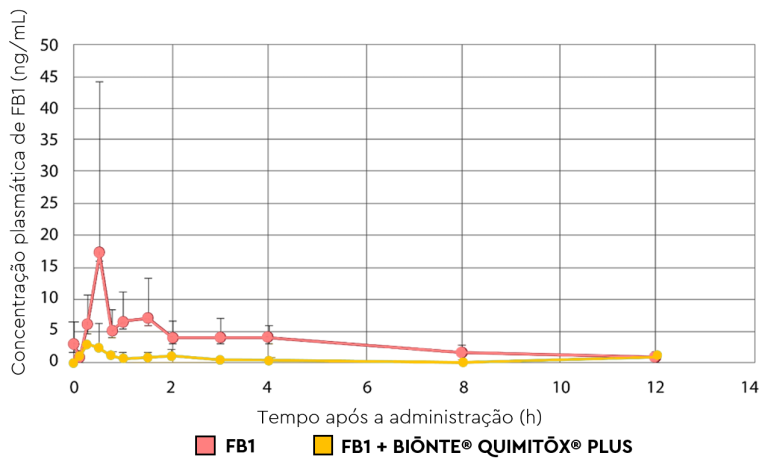
Figura 1. Perfil de concentração plasmática de FB1 em função do tempo, após a administração de um bolo oral de 2,5 mg FB1/kg, com e sem BIŌNTE® QUIMITŌX® PLUS® (3g/kg de peso vivo).
Seguindo esta avaliação de eficácia de BIŌNTE® QUIMITŌX® PLUS, um ensaio in vivo realizado em colaboração com o Instituto Samitec e a Universidade de Santa Maria (Brasil), monitorizou o rácio esfinganina/esfingosina, reconhecido biomarcador de exposição às fumonisinas, em frangos de carne expostos a FB1. Neste caso, foi reportada uma redução de 3,8% neste parâmetro de referência, podendo-se afirmar que o produto é altamente eficaz face às fumonisinas (EFSA, 2010, 2018; Guerre et al., 2022).
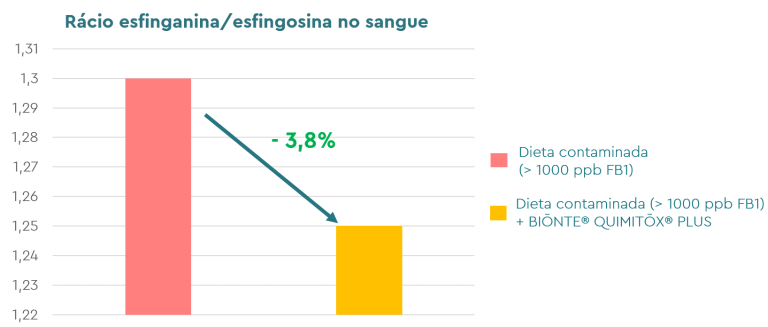
Figura 2. Rácio esfinganina/esfingosina em frangos de carne expostos a FB1, e a FB1 + BIŌNTE® QUIMITŌX® PLUS.
Dentro deste mesmo ensaio, BIŌNTE® QUIMITŌX® PLUS melhorou o rendimento produtivo dos frangos de carne expostos à dieta contaminada. Foi reportado um incremento no peso corporal (+0,7%), ganho diário médio (+2,9%) e na superfície de absorção intestinal (+14,6%), parâmetros alterados pela exposição a fumonisinas. Do mesmo modo, o produto reduziu o peso relativo do fígado dos animais (-6,1%), indicativo do alívio os efeitos inflamatórios destas micotoxinas (+12,9%), o que contribuiu para manter a integridade hepática nos frangos de carne expostos a FB1 (Figura 3).
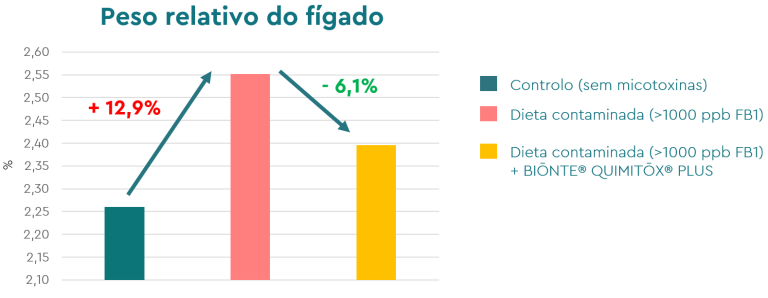
Figura 3. Peso relativo do fígado em frangos de carne não expostos a micotoxinas, expostos a FB1, e expostos a FB1 + BIŌNTE® QUIMITŌX® PLUS.
Por outro lado, a eficácia de BIŌNTE® QUIMITŌX® PLUS em galinhas poedeiras expostas a fumonisinas foi testada, dada a importância dos efeitos das micotoxinas nesta categoria produtiva. Para isso, realizou-se um estudo de campo no México, num grupo de galinhas expostas a uma dieta contaminada naturalmente por fumonisinas, além de AFB1 e deoxinivalenol (DON). O ensaio mostrou melhorias significativas no desempenho produtivo, com uma redução no índice de conversão alimentar (-5,8%) e um aumento na percentagem de ovos comercialmente aptos (+2,7%). Por outro lado, observou-se uma diminuição de 0,25% na mortalidade e melhorias na saúde hepática confirmadas mediante necropsias.
Eficácia de BIŌNTE® QUIMITŌX® PLUS face às fumonisinas no gado suíno
O gado suíno é altamente sensível às fumonisinas, com quadros específicos de patologia respiratória. É por isso que a eficácia de BIŌNTE® QUIMITŌX® PLUS foi demonstrada nesta espécie, através de diferentes estudos focados em leitões desmamados e porcas reprodutoras, em colaboração com a Universidade da Tessália (Grécia).
Uno dos estudos focado em leitões incluiu uma dieta naturalmente contaminada por FB1 e FB2. Os resultados do mesmo revelaram um aumento no peso corporal (+19,5%) e na ingestão de alimento (+24,4%) dos animais; além de uma redução significativa da taxa de mortalidade, justificada por uma melhoria da resposta imunitária e da saúde geral destes animais jovens altamente suscetíveis a qualquer patologia secundária. Neste contexto, BIŌNTE® QUIMITŌX® PLUS também demonstrou a sua capacidade para reduzir os biomarcadores de stresse oxidativo (Figura 4); e os resultados histopatológicos mostraram a sua capacidade para contrariar as lesões causadas pelas fumonisinas, no fígado (degeneração e infiltração) e no epitélio intestinal (redução da superfície de absorção nutricional).
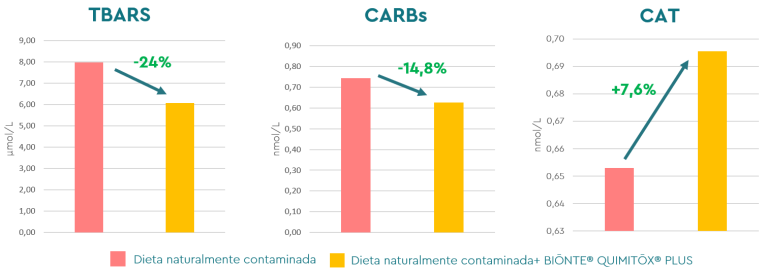
Figura 4. Marcadores de stresse oxidativo em leitões expostos a fumonisinas (FB1, FB2) com e sem BIŌNTE® QUIMITŌX® PLUS. *Substâncias reativas do ácido tiobarbitúrico (TBARS), Carbonilos proteicos (CARBs) e Capacidade antioxidante total (CAT).
Cabe acrescentar que estes resultados foram corroborados num segundo estudo in vivo realizado em leitões, neste caso expostos a fumonisinas em associação com aflatoxina B1 (AFB1). De novo, BIŌNTE® QUIMITŌX® PLUS demonstrou a sua capacidade para melhorar os parâmetros produtivos, a saúde dos órgãos e o estado antioxidante dos animais expostos a esta dieta cocontaminada.
Em relação à eficácia de BIŌNTE® QUIMITŌX® PLUS face a fumonisinas em porcas gestantes, dois estudos in vivo foram realizados com a Universidade de Tessália (Grécia), em condições de multicontaminação. Neste caso, o produto demonstrou o seu efeito em porcas expostas a FB1, FB2, zearalenona (ZEA) e toxina T-2; e desafiadas por FB1, FB2 e AFB1. Em ambos os casos, BIŌNTE® QUIMITŌX® PLUS reduziu o stresse oxidativo causado pelas micotoxinas e melhorou a saúde da glândula mamária das porcas, com um alívio dos sintomas de inflamação (Figura 5).
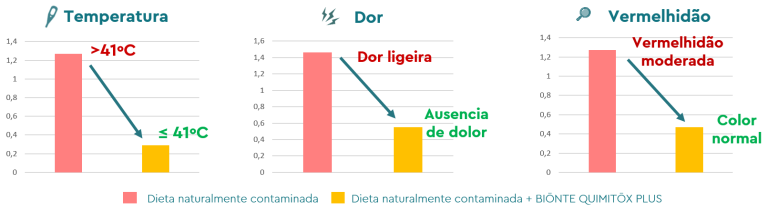
Figura 5. Marcadores de inflamação (temperatura, dor e vermelhidão) em porcas gestantes expostas a uma dieta multicontaminada (FB1, FB2, AFB1) com e sem BIŌNTE® QUIMITŌX® PLUS.
Estes ensaios em porcas incluíram também as características da ninhada, reportando-se em ambos os casos uma redução do número total de nados-mortos e mumificados por ninhada, e um incremento no número de leitões desmamados, graças à administração de BIŌNTE® QUIMITŌX® PLUS (Figura 6).
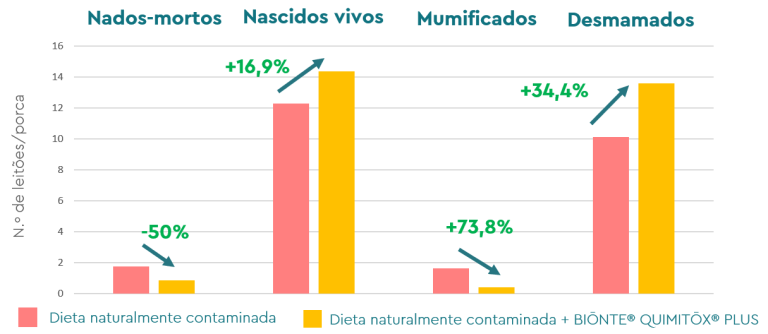
Figura 6. Características da ninhada em porcas expostas a uma dieta multicontaminada (FB1, FB2, ZEA, T-2) com e sem BIŌNTE® QUIMITŌX® PLUS.
Eficácia de BIŌNTE® QUIMITŌX® PLUS face às fumonisinas em ruminantes
Em relação à eficácia de BIŌNTE QUIMITŌX PLUS face às fumonisinas em ruminantes, realizou-se um ensaio in vitro em fluido ruminal com a Universidade Católica del Sacro Cuore (Itália). Este mostrou a capacidade de BIŌNTE® QUIMITŌX® PLUS para mitigar os efeitos prejudiciais induzidos por estas micotoxinas em vacas leiteiras, já que alcançou uma diminuição de 63% na concentração de fumonisinas no fluido ruminal das vacas tratadas (Figura 7).
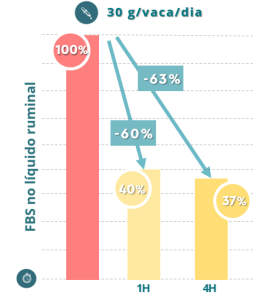
Figura 7. Descida da concentração de fumonisinas (FBS) no líquido ruminal com BIŌNTE® QUIMITŌX® PLUS.
Finalmente, BIŌNTE QUIMITŌX PLUS também demonstrou a sua eficácia face às fumonisinas em ovelhas leiteiras, em condições de cocontaminação com AFB1 e ocratoxina A (OTA), durante as fases de parto e lactação. Neste estudo realizado em colaboração com a Universidade de Tessália (Grécia), a suplementação produziu uma redução de 44% na incidência de febre pós-parto e uma diminuição de 34% em casos de mastite (Figura 8).
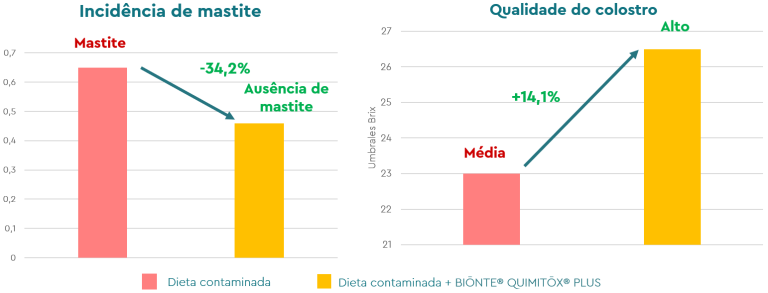
Figura 8. Incidência de mastite e qualidade do colostro em ovelhas leiteiras expostas a uma dieta multicontaminada (FB1, FB2, ZEA, T-2) com e sem BIŌNTE® QUIMITŌX® PLUS.
No que diz respeito à produtividade, registou-se uma melhoria significativa da qualidade do leite, com um aumento de 10% ao nível da gordura, e de 1,5% na proteína. A qualidade do colostro melhorou em 14% (valores Brix), o que garante uma melhor imunidade neonatal (Figura 8). Além disso, o produto mostrou efeitos hepatoprotetores significativos, reduzindo enzimas indicadoras de dano hepático, como ALT (-73%) e AST (32,4%) (Figura 9).
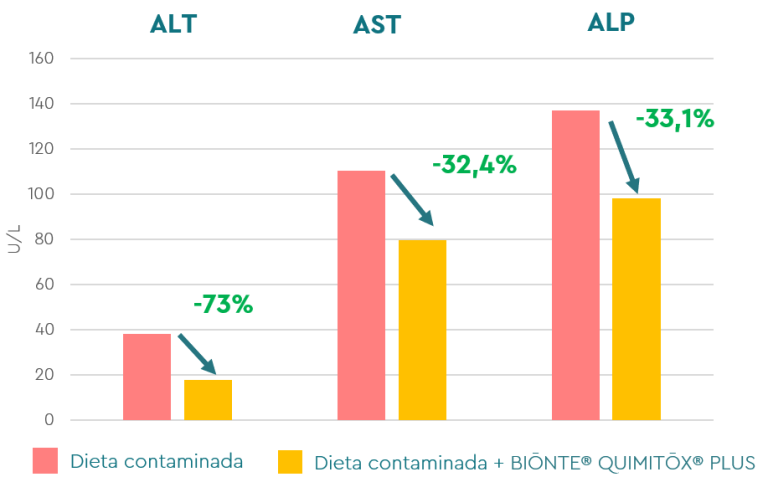
Figura 9. Marcadores de dano hepático em ovelhas leiteiras expostas a uma dieta multicontaminada (FB1, FB2, ZEA, T-2) com e sem BIŌNTE® QUIMITŌX® PLUS. *Alanina aminotransferase (ALT), Aspartato aminotransferase (AST) e Fosfatase alcalina (ALP).
Conclusão
Desta forma, BIŌNTE® QUIMITŌX® PLUS demonstrou a sua eficácia face às fumonisinas, um grupo de micotoxinas altamente prevalente a nível mundial e conhecido pelos seus efeitos negativos na saúde e no rendimento de diversas espécies animais. Estas micotoxinas, presentes comummente em cereais e subprodutos vegetais da alimentação, podem afetar órgãos-chave como o fígado, o sistema imunitário e o trato digestivo, provocando perdas produtivas importantes.
Os estudos in vitro e in vivo mostraram que a suplementação com BIŌNTE® QUIMITŌX® PLUS não só mitigou os efeitos tóxicos das fumonisinas, como também melhorou parâmetros produtivos, além de favorecer a saúde hepática e intestinal. Estes resultados confirmam que BIŌNTE® QUIMITŌX® PLUS é uma ferramenta fiável para proteger a saúde animal e otimizar o desempenho produtivo face à presença de fumonisinas.